Agentic AI, Stablecoins, Open Finance: Four Themes Set to Shape Bahrain Fintech to 2030
Bahrain Fintech Bay expects agentic AI, regulated stablecoins, open finance and cross-border payments to restructure the sector between 2027 and 2030.

Bahrain Fintech Bay expects four structural themes to reshape the kingdom's fintech sector between 2027 and 2030: agentic AI, stablecoins, open finance and cross-border payments. The outlook, published in a November 2026 report on the local fintech ecosystem, is built on progress the hub observed from 2024 through 2026 rather than on projections alone.
Of the four, agentic AI carries the most weight. The hub calls it the central frontier of financial services innovation and expects AI and automation to become core architecture for the industry, not a layer bolted onto existing systems. Agentic systems differ from earlier automation in what they do unsupervised. They initiate payments, negotiate financing terms, execute trades and trigger compliance checks against real-time data without a human reviewing each step.
The plumbing is largely built
Bahrain's argument is that most of the infrastructure such agents need is already in place. A national eKYC layer supplies verified digital identity. Standardized open banking APIs provide real-time data access and payment initiation. Regulated stablecoin rails handle programmable settlement. Data sovereignty legislation keeps financial data inside a governed perimeter.
What remains, according to Bahrain Fintech Bay, is a know-your-agent framework. Such a framework would set out an agent's identity, the scope of its authorization, the limits on its decisions and who is accountable when it makes an error. Until those definitions exist, delegating the movement of money to software stays legally untidy.
Four use cases closest to deployment
The hub identifies four applications it considers nearest to adoption.
- Consumer agentic commerce. AI agents track prices in real time, apply a user's standing rules and initiate payment through an open API, with no per-transaction review by the customer.
- Enterprise treasury automation. Agents manage liquidity, monitor outgoing obligations, forecast inflows and move idle balances into a Shariah-compliant yield-bearing stablecoin.
- Automated SME credit decisioning. Lending agents retrieve open banking and credit data, assess risk, verify authorization and disburse funds instantly.
- Automated corporate payroll. Agents verify employee identity records, schedule batch salary payments and process payments for regional staff.
Each case leans on the same combination of verified identity, consented data and programmable money. None of them requires a new institution. That is the point.
Stablecoins shift from holdings to rails
Regulated stablecoins are expected to move out of the digital-asset corner and into settlement infrastructure for corporate treasury, trade finance and cross-border routes by 2027-2030. The trend runs with Bahrain's rulebook rather than against it. The Central Bank of Bahrain regulates issuers under the Stablecoin Issuance and Offering Module, which took effect in July 2025. Licensed issuers may issue single-currency stablecoins backed by the Bahraini dinar, the US dollar or another fiat currency the central bank approves.
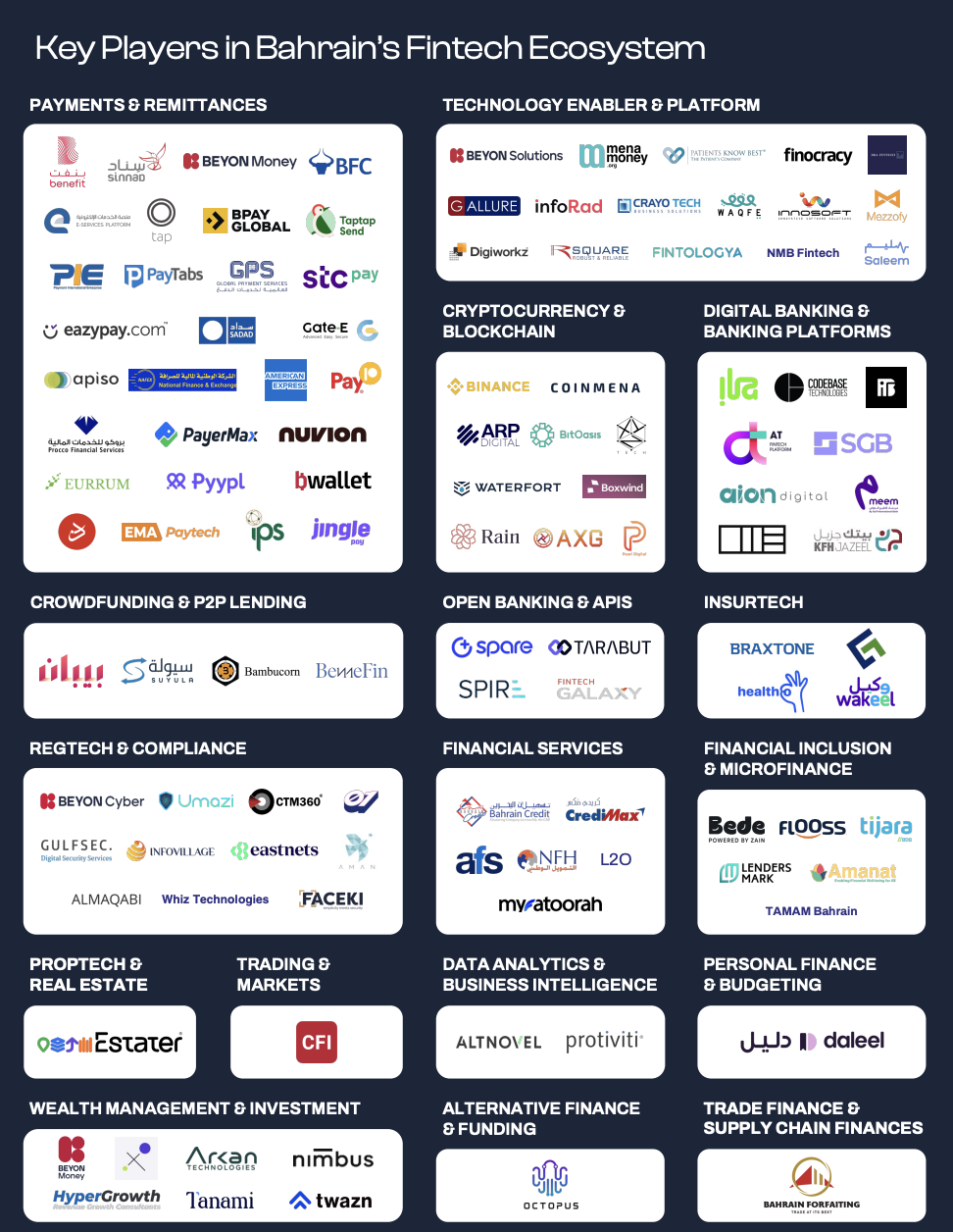
The commercial pipeline moved quickly once the rule was live. AX Coin Bahrain and Pearl Digital Issuance Company were among the players that secured central bank licenses or in-principle approval.
Stablecoins are also expected to become a prominent payment method inside agentic finance. They offer stable digital value that settles in real time, sidestepping both the volatility of unbacked crypto assets and the clearing delays of traditional rails.
Open finance and an unusual distribution channel
Open finance is the least developed of the four themes. It extends open banking by adding insurance and investment data to the consent framework, and it will be built on the open banking environment Bahrain already has.
Tarabut, an embedded finance and open banking platform that began in Bahrain and is now based in Riyadh, is described as the leading regulated open banking platform in MENA, holding licenses in several regions.
Where Bahrain looks different from most markets is distribution. All three major telecommunications operators hold financial licenses, which gives them reach that pure-play fintech firms cannot match.
Batelco operates Beyon Money, a digital financial super-app offering a stored-value wallet, prepaid Visa cards, open banking connectivity, remittances and Shariah-compliant investments. STC Bahrain runs stc pay, an all-in-one mobile wallet and financial services platform covering wallet services, payroll, cards and remittances. Zain operates Bede, a Shariah-compliant digital micro-finance platform and mobile app.
The institutional layer grew alongside consumer services. KFH, Al Baraka Islamic Bank, BBK and NBB are among the Bahraini banks that expanded banking-as-a-service offerings, which let businesses and fintech firms reach virtual accounts, digital payments and trade finance tools without holding a banking license. Bahrain Fintech Bay expects embedded finance to be a primary delivery channel for financial services in the kingdom by 2030. By then, licensing and data access are expected to separate financial from non-financial providers more sharply than the customer touchpoint does.
Cross-border corridors and the volume base
Digital payments and cross-border innovation are expected to remain a leading trend through 2030. The direction of travel is toward blockchain-based settlement, which can cut both transaction cost and settlement time.
The stakes are local as well as regional. Cross-border efficiency matters for remittance flows from Bahrain's large expatriate workforce, and for trade finance across GCC markets. Stablecoin-denominated settlement for high-volume GCC corridors is identified as the most commercially significant near-term opportunity, because trade flows, investment settlements and remittances among Bahrain, Saudi Arabia and the UAE form a substantial and predictable base of volume.
A vertical mix in transition
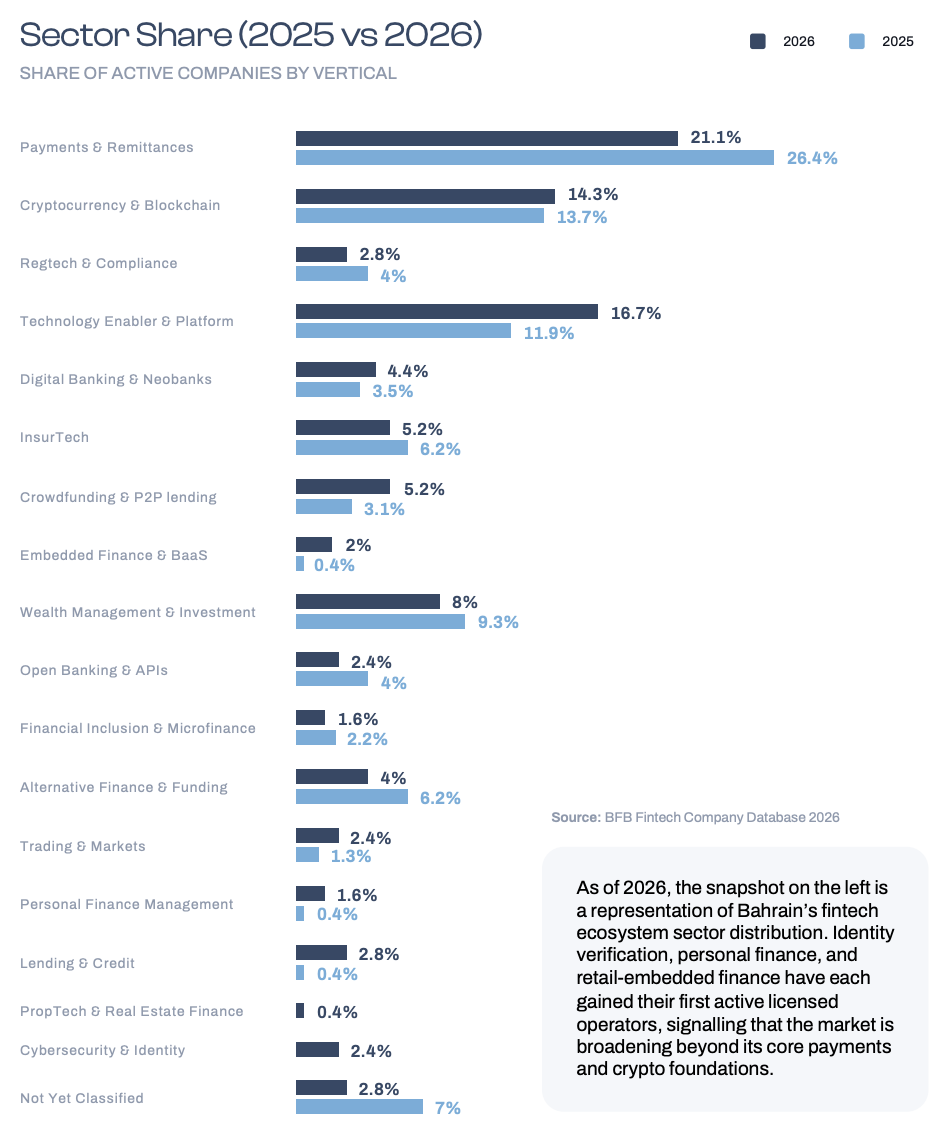
Active Bahrain fintech companies now operate across 17 verticals. Payments and remittances were the largest category in 2026 at 21.1% of active companies, ahead of cryptocurrency and blockchain at 14.3%.
The movement underneath those totals is more telling. Technology enabler and platform companies rose to 16.7% of active companies in 2026 from 11.9% in 2025, the strongest year-over-year growth of any vertical, a shift the hub reads as a maturing ecosystem. Consumer fintech is reaching market saturation, faces high user acquisition costs and has proven vulnerable to economic shifts. Providers are responding by selling software and rails to businesses, where a single contract can deliver predictable recurring revenue and scale.
Why the four themes arrive together
The themes are not separate bets. They are the same stack seen at different layers: identity, consented data, programmable settlement and the software that acts on all three. Agentic AI cannot move money without stablecoin rails or open APIs, and stablecoins cannot reach corporate treasury without the licensing that makes them bankable. The binding constraint is the know-your-agent framework, and that is a legal question rather than an engineering one. Bahrain has already answered the stablecoin question in regulation; the agent question is still open, and the four use cases above will wait on it.


