AI-enabled attacks jump 89% as agent identity moves to the top of the security agenda
Autonomous agents that hold their own credentials and execute transactions are forcing security teams to answer a question built for humans: who authorized this action?

CrowdStrike's 2026 Global Threat Report puts a figure on the shift: AI-enabled adversary activity climbed 89% year on year in 2025. Average eCrime breakout time, the interval between first access and lateral movement inside a network, fell to 29 minutes. The fastest recorded case took 27 seconds. Attackers also turned legitimate generative AI tools against more than 90 organizations, using them to compose malicious commands and extract sensitive data.
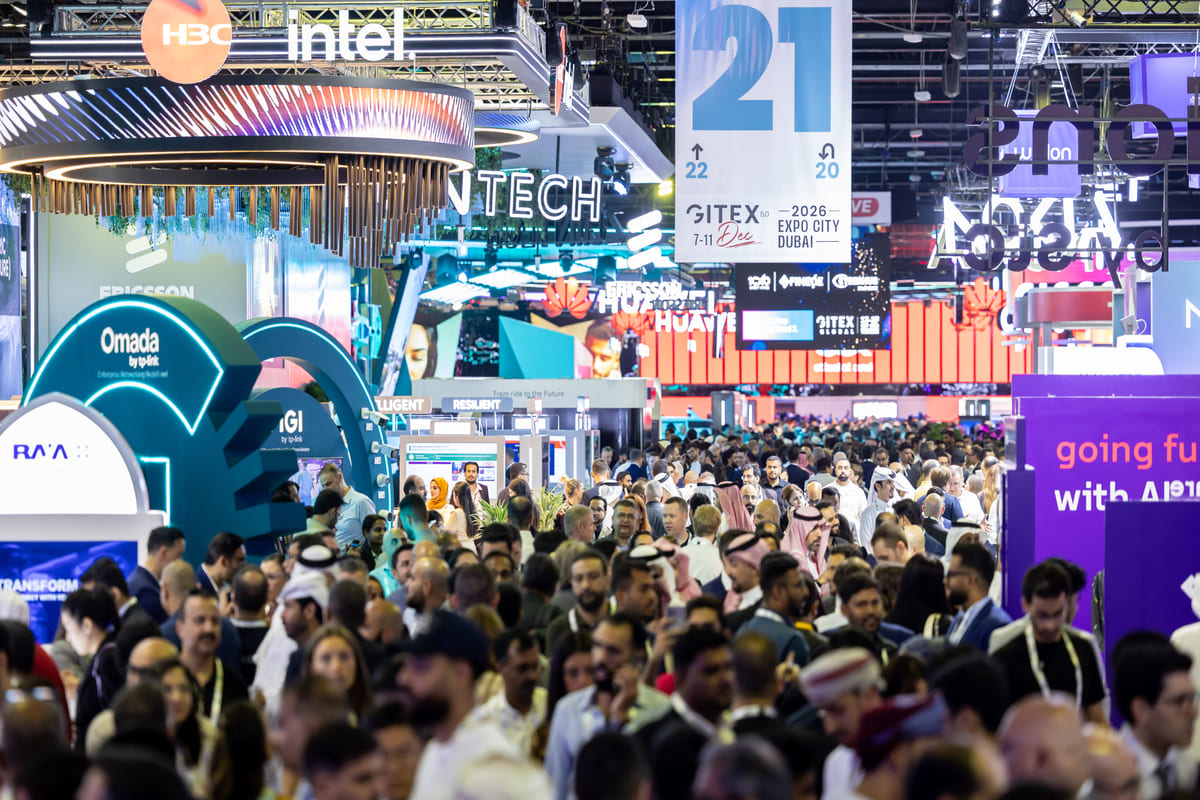
Those numbers arrive as autonomous AI agents leave the experimental tier and enter enterprise systems. An agent can reach sensitive data, call APIs, execute transactions and act with little human oversight. Cybersecurity companies gathering at GITEX Cyber Valley 2026, which runs inside GITEX GLOBAL from December 8 to 11 at Dubai Exhibition Centre in Expo City Dubai, are placing the governance of those agents at the center of the security agenda for 2027 and beyond.
The risk perception has moved quickly. The World Economic Forum found that 87% of respondents named AI-related vulnerabilities the fastest-growing cyber risk during 2025, and 94% said AI would be the most significant driver of cybersecurity change in 2026.
From answers to actions
The question security teams are asking has changed. Concern once centered on what a model could generate; it now centers on what software can do on its own. Cloudflare expects AI agents to account for a far larger share of internet activity by 2030, as businesses hand more work to autonomous systems that interact with websites, applications and digital services. Such a system may act on behalf of a person or a company while presenting its own credentials and permissions.
Waseem Hattar, Cloudflare's Country Manager for UAE and Oman, described the 2027 shift as one "from AI that answers questions to AI agents that take action across the Internet." Winning teams, he said, will ask whether an agent is authorized rather than whether a user is real.
Cloudflare will use GITEX GLOBAL to show tools for shadow AI visibility, workload protection and AI model access management. The company is also expanding its data center footprint in the UAE as demand grows for local control over AI workloads.
A digital workforce with its own permissions
Forcepoint frames autonomous agents as a new category of digital workforce standing alongside human employees. Its projection is striking: by 2030, a business with 40,000 employees could run millions of AI-powered working entities. Agents pose a different problem than earlier automation because they operate continuously, talk to other systems and process large volumes of information at machine speed.
Samer Diya, Senior Vice President for EMEA at Forcepoint, said protecting sensitive data and governing AI are becoming "a single discipline."
The company will exhibit an AI Data Security platform built to protect sensitive information across cloud, networks, endpoints and AI environments, and to help customers manage autonomous agents alongside unsanctioned AI use. Its ARIA AI Assistant lets security teams write and enforce data-protection policies in natural language.
Most enterprise security models were designed around people, devices and applications. They were not built for software identities that make operational decisions. Keypasco argues that organizations need to establish which agent is acting, who authorized it, what permissions it holds and where accountability lands when it executes a task.
Chengi Lin, Keypasco's CEO, said every operational AI agent will need "a verifiable identity, defined authority, delegated permissions, and auditable records."
Keypasco is building a Trust Identity Platform that extends identity governance from people and devices to agents. The approach gives each agent a digital identity, ties it to the person or organization that authorized it and sets boundaries on access and execution. Under its "Know Your Agent" framework, the company covers operating identity, authorization relationships, permissions and the execution environment. It plans to demonstrate the next version of the platform at GITEX GLOBAL, carrying Zero Trust governance into enterprise AI workflows.
Treat an agent like a member of staff
Rapid7 takes a comparable line, arguing that privileged AI agents should be handled like employees with access to sensitive business systems.
Gopan Sivasankaran, Regional Director for Middle East and Africa at Rapid7, said an agent with business access needs safeguards including "an accountable manager, appropriate permissions and defined responsibilities."
The company's guidance is specific. Significant agent actions should be logged, human approval should be required where the stakes justify it, and access should be revoked quickly when circumstances change. It recommends a dedicated identity for every agent, least-privilege limits on permissions, human sign-off for high-impact actions and tamper-resistant logs held outside the agent's own control.
Rapid7 also warns about excessive agency, the condition in which an AI system holds more data, applications or actions than it needs. The danger grows when agents reach external tools through technologies such as Model Context Protocol. At GITEX GLOBAL, Rapid7 will demonstrate its AI-enabled Command Platform at Mindware's stand, showing agentic workflows that gather evidence, support investigations and automate repetitive security work.
National exposure
The UAE Cyber Security Council recorded more than 800,000 cyberattack attempts per day during recent periods, a figure cited when the council and CPX launched the UAE Cyber Factory earlier this year. The initiative is intended to strengthen national cyber sovereignty and sharpen the country's ability to anticipate, detect and respond to advanced attacks. The local threat environment has increasingly involved AI, state-linked activity and strikes against critical infrastructure.
GITEX Cyber Valley will convene international security vendors and government security leaders around AI governance, sovereign security, supply-chain risk, the convergence of IT and operational technology, and post-quantum readiness. The GITEX Cyber Stage program will concentrate on AI governance, digital identity, critical infrastructure and human-led defense.
H.E. Dr. Mohamed Al Kuwaiti, Head of Cybersecurity for the UAE Government and a Cyber Valley speaker, said cyber resilience is a strategic imperative amid escalating state-sponsored threats and AI-powered attacks, and that the event brings together the expertise and partnerships needed to advance the UAE's vision for proactive cyber defense and secure digital progress.
He is joined on the speaker roster by Michelle Bordachar Benoit, National Director of Chile's National Cybersecurity Agency; Ioannis Alexakis, Director General of Greece's National Cybersecurity Authority; researcher Mikko Hyppönen; Kevin T. Shin, Head of Information Security at Samsung Semiconductor; Corey Deng, Chief Security Officer at Huawei; and Christian Reilly, Field CTO at Cloudflare.
The event preview describes AI agents as testing "the limits of human control" and places agent accountability alongside post-quantum security and machine-speed defense among the main Cyber Valley themes. GITEX GLOBAL's 46th edition opens with the GITEX Summit at Dubai World Trade Centre on December 7, followed by a four-day exhibition at Expo City Dubai. GITEX and Expand North Star are expected to draw more than 6,000 enterprise and startup exhibitors from 180 countries.
The practical difficulty is that agent governance borrows from disciplines that have historically sat apart. Identity teams know how to provision and revoke access for staff. Data protection teams know how to classify and track sensitive information. Network and endpoint teams know how to watch for unusual traffic. An autonomous agent crosses all three at once, receiving delegated authority, choosing how to complete a task and coordinating with other agents without a person watching every step. That is why permissions, logging, approval and revocation keep surfacing in the same conversations as model access and data loss prevention. Enterprises already have machinery for deciding what an employee or a device may reach. Extending it to software that acts on its own is the work now underway.
The measure of progress by 2027 will be narrow and unglamorous: whether a security team can name every agent running in its environment, produce the record of who authorized each one, and cut off access before the 27-second mark arrives.


