AI Report 2026: Cheap Models, Grid Limits and Dubai's Deadlines
A 100-page study tracks a 280-fold fall in model costs, US$226 billion of quarterly funding and a UAE push that turned AI targets into timetables.

The State of AI 2026 Report was released on October 27, 2026, at 100 pages. Lucidity Insights developed it with Dubai AI Campus, with backing from the DFINITY Foundation. Its scope runs from benchmark performance to electricity supply, and its organising idea is an emerging AI power corridor through the UAE and Saudi Arabia.
Erika Welch, chief content officer at Lucidity Insights, gave the launch keynote and selected ten findings from the report to carry the argument. Her framing was direct. Whether AI would reorganise the global economy, she said, is settled. What is not settled is who is organised to capture it, and how quickly they can move.
A benchmark that went from marginal to near-total
AI agents now fix 96% of real-world software bugs on SWE-bench Verified. In late 2023, the best systems available fixed 4%. That is the sharpest curve in the report, and it arrived in under three years.
The number comes with a caveat that the report does not soften. METR had human maintainers review the AI-generated fixes that passed the benchmark, and those reviewers said they would have rejected about half of them. A patch that resolves a test case is not the same object as a patch a team will merge. The report's conclusion is that AI can draft a solution, but a person still has to sign off, and the distance between those two things is where engineering budgets currently sit.
The price of a token collapsed
When ChatGPT launched in November 2022, GPT-3.5-level capability cost roughly US$20 per million tokens. By October 2024 the same class of model cost US$0.07 per million tokens. More than 280 times cheaper in under two years.
Put the two curves together and the argument changes shape. Rising capability on one side, collapsing cost on the other, means autonomy stops being something a vendor demonstrates and becomes something a buyer procures. The report states it plainly: the decision is now a procurement question. That reframing explains why agent pilots moved out of innovation labs and into finance departments, where the comparison is no longer against a chatbot but against a salary line.
Capital at infrastructure scale
AI companies raised US$226 billion in the first quarter of 2026 alone, more than the whole of 2025. A single OpenAI round of US$122 billion accounted for more than half of that quarter's total.
Amazon, Alphabet, Microsoft and Meta are projected to spend above US$720 billion in capital expenditure during 2026, close to five times what they spent in 2023. Welch's description of the shift is that AI is no longer financed like software. It is built and financed like power grids and railways.
Concentration is the risk that follows. When one company's round is larger than most sectors raise in a year, the market's health depends on a small number of balance sheets continuing to spend, and the capex figures show those balance sheets already committed.
Revenue has begun to appear in the same register. Anthropic's annual recurring revenue climbed from about US$1 billion in 2024 to US$65 billion by August 2026. Claude Code went from zero to US$2.5 billion in annualised revenue in nine months. NVIDIA became the first company to pass a US$5 trillion market value.
Electricity becomes the binding constraint
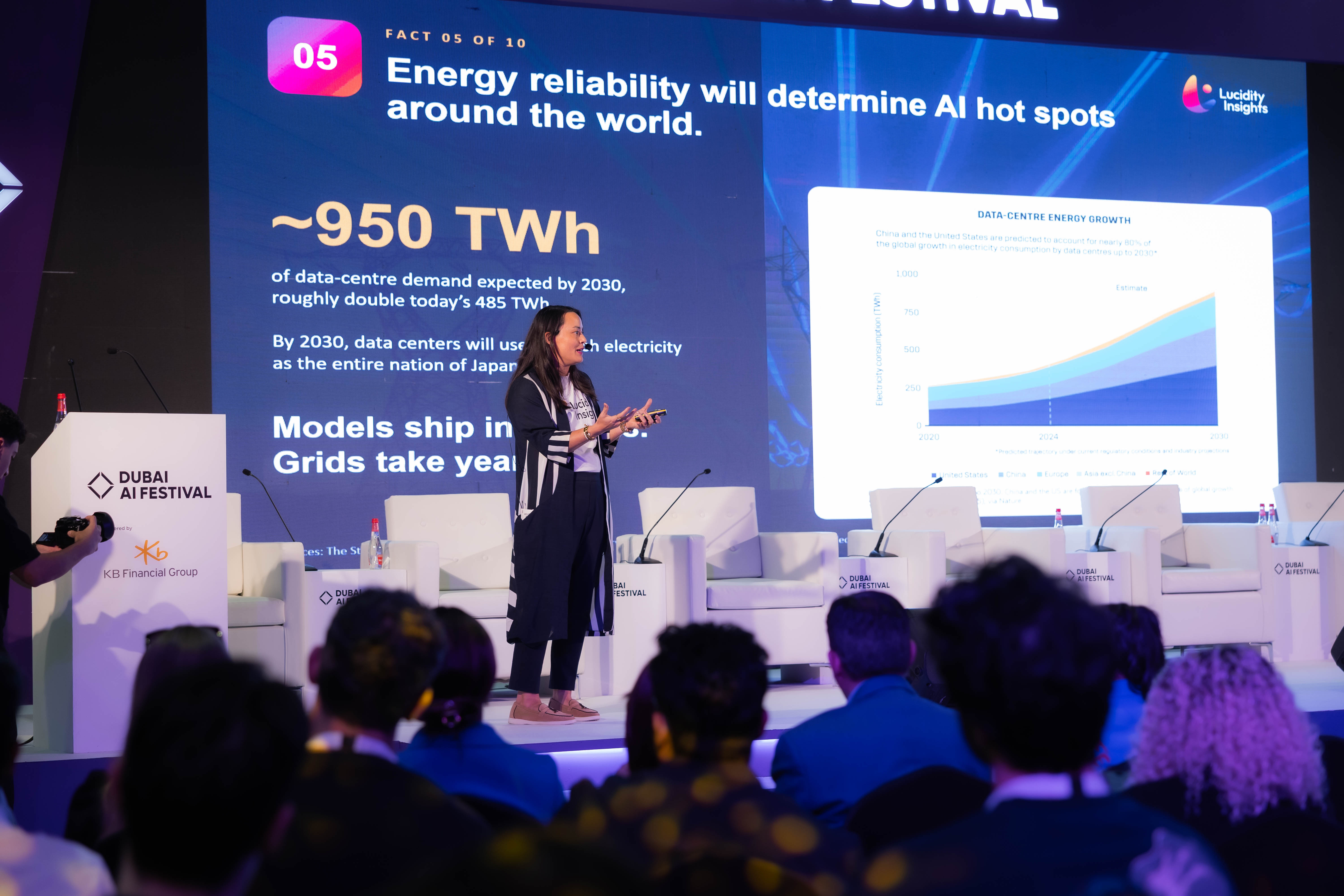
Data centres used about 485 TWh in 2025. The IEA expects them to use roughly 950 TWh by 2030, slightly more than Japan consumes today.
Welch called electricity the emerging constraint on AI, and the mismatch is one of tempo. Models ship in months. Grids take years to build, permit and connect. A frontier lab can release a new system on a quarterly cadence; the substation that feeds it answers to a different schedule entirely. Welch noted that Gulf countries may gain an advantage here by standing up AI-ready energy grids at record speed, which would make power availability, not model access, the thing that decides where capacity lands.
Evidence from clinics and laboratories
Sweden's MASAI trial covered more than 100,000 women. AI-supported screening detected 80.5% of breast cancers. Standard reading by two radiologists detected 73.8%. The gap is the kind of result that reshapes a radiology workflow before it reshapes a policy document.
In drug development, Insilico Medicine dosed the first patient in a Phase III trial in September 2026 for a drug whose development was led entirely by generative AI. Phase III is where most molecules fail, so the trial is a test of the method as much as the compound.
The security ledger runs the other way
Google Mandiant reported that through 2025, attackers exploited software flaws an average of seven days before a patch existed. Machine identities inside enterprises — bots, agents and APIs — outnumber human identities by roughly 109 to one. Every additional autonomous agent adds to that population and widens the surface that has to be defended, which is why security teams read capability gains and exposure gains in the same breath.
Adoption is wide, returns are thin
Nine in ten organisations use AI regularly. Only 6% attribute 5% or more of their earnings to it. Among billion-dollar firms, 40% are scaling AI agents, up from 27%. Smaller companies sit at 22% adoption, with no change since 2025.
The geographic split is 27.5% in the Global North against 15.4% in the Global South. The report's finding is that the difference is not access to models. It is willingness to redesign workflows and reorganise companies around the technology. That distinction puts the constraint inside management rather than inside procurement, and it explains the flat line at smaller firms: the tools are available, the reorganisation is not.
Dubai sets deadlines
Microsoft's AI Diffusion Report, released in September 2026, put AI use among working-age adults in the UAE above 70%, the highest rate measured anywhere. Singapore follows at 63%, the United States at 31%, Saudi Arabia at 30%.
Policy has moved at comparable speed. In late April 2026, Sheikh Hamdan bin Mohammed bin Rashid Al Maktoum, Crown Prince of Dubai, directed the emirate's government and private sector to move to agentic AI within two years. Within about six weeks, the UAE committed to shifting 50% of government services onto agentic AI and launched an 80,000-person training programme for government employees. Dubai set out to support 295,000 companies in adopting AI across the same two-year window.
Dubai AI Campus at DIFC targeted 500 AI companies by 2028. It now hosts 505, two years ahead of schedule, and companies there have created more than 2,020 jobs. For global AI firms the campus works as a launchpad into the Middle East, Africa and South Asia. Welch's summary: "Where others set ambitions, Dubai set deadlines."
Where others set ambitions, Dubai set deadlines.
What else sits inside the report
Beyond the ten facts, the document profiles six kingpins of AI and includes ten charts mapping where the technology currently stands. It examines applications in healthcare, cybersecurity, construction and finance, and works through constraints from chip supply to the effect of AI on jobs.
Welch placed the last four years in sequence: 2023 was the year of awakening, 2024 the year of acceleration, 2025 the year of AI agents, and 2026 the year of reckoning. "The race is well underway," she said.


