AIRZAI's Muneeb Mushtaq on Making Scent Part of the Smart Environment
The Canadian tech-fragrance company is pairing AI, neuroscience and hotel partnerships to turn scent into a programmable layer of responsive spaces.
Karim El-Sayed Karim El-Sayed covers company news, policy and regulation across the UAE and wider MENA for Anecdoted, with a focus on how new rules and licences reshape how startups operate. karim@anecdoted.com
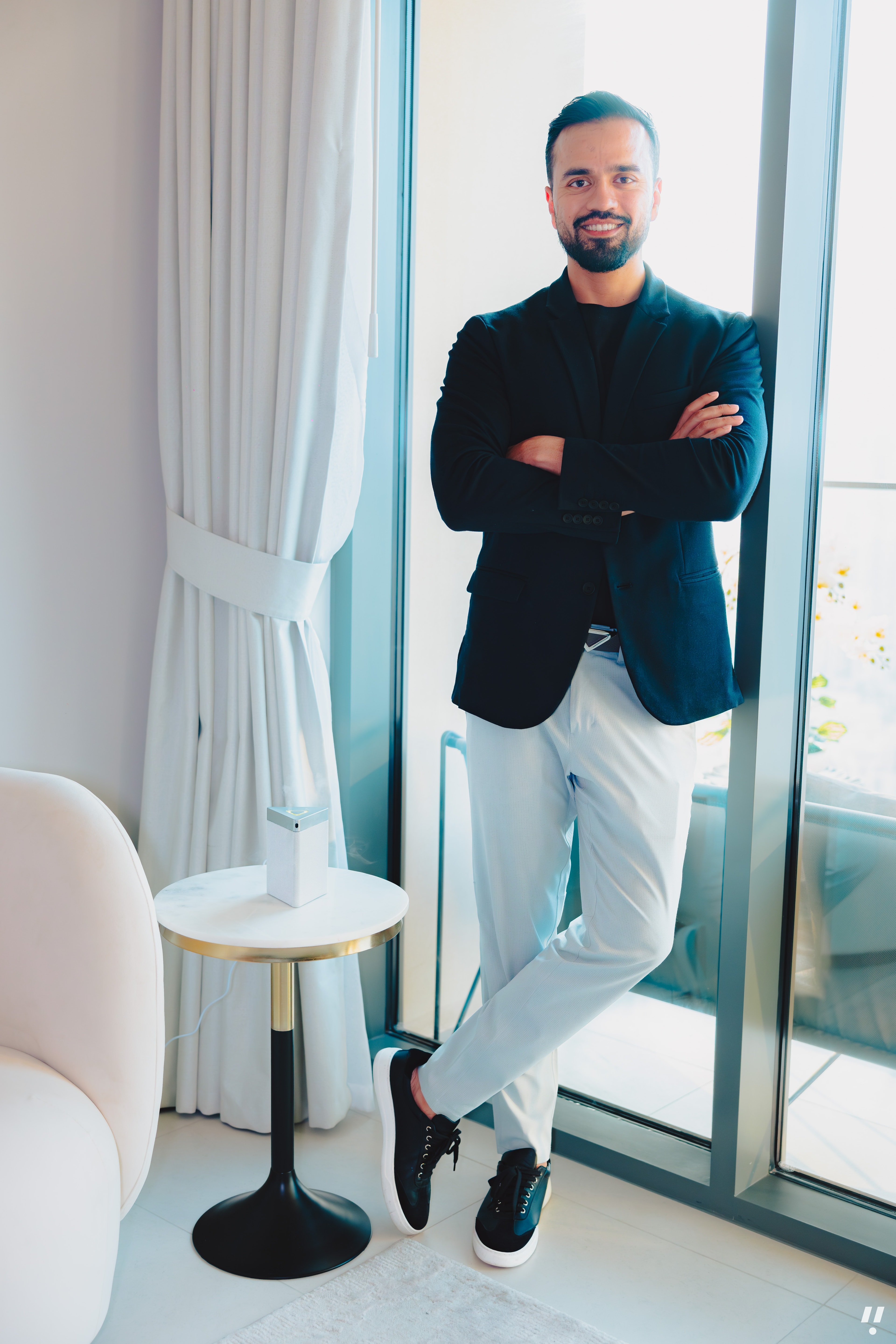
AIRZAI started in 2019 with a gap in the connected home. Lighting, temperature, security, music and appliances could all be programmed and controlled. Scent, largely, could not. Muneeb Mushtaq, the company's founder and chairman, framed it as a simple question: why should fragrance be left out of that system?
AIRZAI is a tech-fragrance business headquartered in Canada with operations across the MENA region. Its first product is a connected waterless diffuser that runs on fragrance pods built around functional scents — energy, focus, meditation and sleep. An app controls the device, and AI learns a user's preferences and schedules over time.
Mushtaq places the larger ambition in a hotel arrival. A traveller lands in Dubai after a long flight and steps into a room that responds before a switch is touched: the lighting shifts, the temperature moves, the soundscape softens and scent eases the passage from travel to recovery. Hours later the same room turns toward sleep, then toward energy and focus the following morning.
That direction sits inside a broader industry movement. The Global Wellness Institute's Touchless Wellness Initiative Trends for 2026 lists ambient wellness and adaptive, individualized environments among emerging trends, pointing to intelligent systems and immersive spaces that support wellbeing with less direct input from the person using them.
As AIRZAI went deeper into scent, neuroscience and behaviour, the founding question changed. What began as an effort to make fragrance programmable became an inquiry into whether surroundings can shape how someone feels or performs. The company has used electroencephalography, galvanic skin response and eye tracking to examine how scent relates to attention, arousal and emotional response. Some of that work has been independently studied at the University of Geneva.
Mushtaq argues that most smart environments do not actually understand the people inside them. A thermostat follows a setting. A diffuser follows a schedule. AIRZAI is building an intelligence layer that ties context, preferences and human signals to the space itself, so a room works toward an outcome instead of waiting for a command.
Hospitality is the commercial proving ground. AIRZAI is working with wellness and hospitality partners and developing collaborations with branded hotel groups it expects to announce as they become public. For Mushtaq, the test is not whether the company can ship another connected device, but whether experienced operators judge sensory technology valuable enough to build into the experiences they sell.
Growth has leaned on partnerships, an approach he carried over from earlier work developing commercial deals across technology, entertainment, consumer brands and hospitality, including with Google and TripAdvisor. Among the people he brought in is industrial designer Fred Bould as chief designer. Bould's credits include the Nest Thermostat, developed by Nest Labs, which Google acquired for US$3.2 billion. He helped shape AIRZAI's scent system and assembled engineers with backgrounds at Apple, Google, GoPro and Fitbit.
The company recently raised US$2 million from investors including the artist and entrepreneur Drake and the therapist and author Marisa Peer. The capital is going toward technology and product development, further research, and deployments in hospitality and wellness, alongside strategic partnerships that would put its systems into hotels, clinics and residences.
Dubai gathers several of those applications into a single market, particularly as the Dubai Longevity Authority, established by H.H. Sheikh Mohammed bin Rashid Al Maktoum, UAE Vice President, Prime Minister and Ruler of Dubai, works to position the emirate as a hub for regulated longevity, wellness and advanced health care. Mushtaq describes the city as a route to hotel groups, developers, wellness concepts and longevity clinics, and as a place to move intelligent environments from discussion into physical spaces.
He is direct about the constraint running underneath all of it. A vision can be broad, he says, but execution has to be narrow. Founders see a decade ahead and try to build all of it at once, while customers need a reason to care now. His own measure of success is assembling the technology, partnerships, people and capital to make responsive spaces something people can actually walk into.
His advice for wellness founders
- Start from a human outcome, not a trend. The popularity of AI, longevity or wellness is not a reason to build anything. Clarity about what improves for someone is.
- Hold a very large vision and a very narrow entry point. AIRZAI did not set out to rebuild the entire environment. It took one missing piece of the smart home.
- Build ecosystems, not just products. Wellness overlaps with science, technology, hospitality, culture and human behaviour, and the biggest openings come from aligning the right partners rather than owning every part yourself.

