Digital Payments to Remain Qatar's Largest Fintech Segment Through 2028
Invest Qatar projects digital payments at QAR 181 billion by 2028, with e-commerce growing at a 16% CAGR and wallets taking about a third of the market.

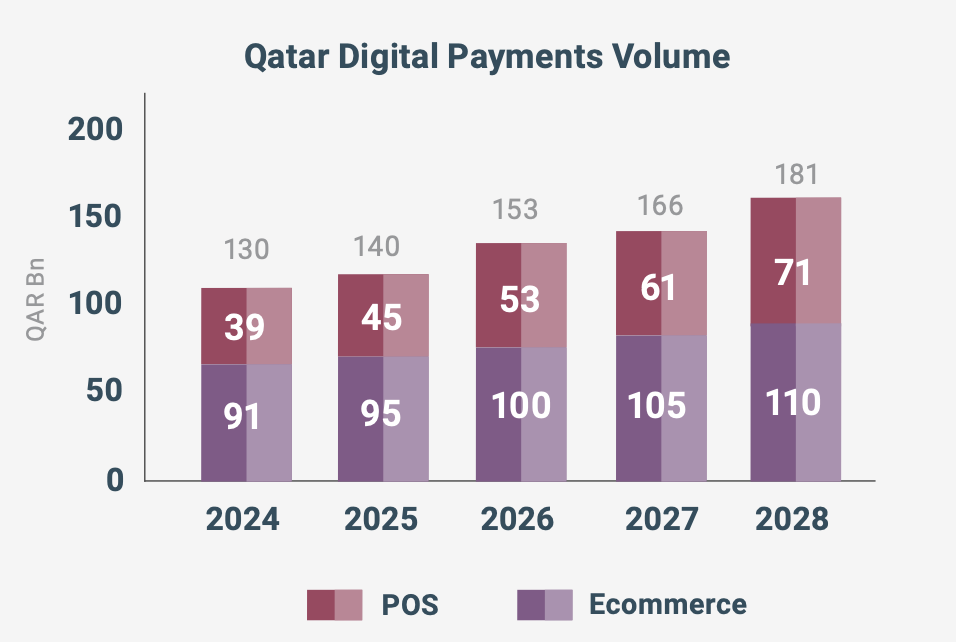
Digital payments will remain the largest segment of Qatar's fintech market through 2028, according to estimates from Invest Qatar. The segment is projected to reach QAR 181 billion (US$49.5 billion) by then, up from QAR 153 billion (US$41.8 billion) in 2026. The figures come from the organization's Qatar Fintech Landscape report, dated October 2026.
E-commerce is doing most of the pushing. Online payments are forecast to grow at a 16% compound annual rate, from QAR 100 billion (US$27.44 billion) in 2026 to QAR 110 billion (US$30.1 billion) in 2028. Point-of-sale payments move more slowly: a 5% CAGR takes them from QAR 53 billion (US$14.5 billion) to QAR 71 billion (US$19.4 billion) over the same two years.
The division of labor between incumbents and newcomers is settling into a pattern. Invest Qatar expects payment companies and startups to keep specializing in payment gateways and POS solutions, while banks concentrate on payment processing. International players and local banks are seen as the drivers of market leadership, with telecom operators and fintech startups contributing alongside them. Qatar National Bank, Commercial Bank of Qatar and Doha Bank are among the country's leading banks.
SADAD Payment Solutions, a licensed fintech independent acquirer, covers much of the merchant stack: payment gateway integrations for websites and apps, shareable payment links, e-invoices, POS terminals, an e-wallet, a digital payment platform and payment cards. It connects directly to the national networks NAPS and QPay and serves more than 10,000 merchants in Qatar.
MyFatoorah, a Kuwait-based gateway and fintech platform, helps merchants accept online and in-person payments across eight countries, Qatar among them. It reports more than 80,000 merchants on its books.
Dibsy, a Qatari payment infrastructure company, lets businesses take online and in-store payments through digital checkout systems, recurring payments, payment links and POS terminals. It processed close to 11 million transactions in 2025 and received Open Banking Express Sandbox Approval from the Qatar Central Bank the same year. In the first quarter of 2026 its transaction count rose 49% year on year and payment volume grew 112%. It was named in a 2026 regional ranking of 50 fintech companies, recognized for growth and recent milestones alongside other regional leaders.
Wallets are the fastest-moving channel inside the market. Digital wallet transactions are expected to reach QAR 65 billion (US$17.8 billion) by 2028, about 34% of the country's digital payments. Wallet spending online is forecast to grow at a 26% CAGR, and wallet spending at the point of sale at 21%.
Apple Pay, Google Wallet and Samsung Wallet are all available in Qatar. The local alternatives are Ooredoo Money, a mobile wallet operated by Ooredoo Fintech, a subsidiary of Ooredoo Group; iPay, a licensed e-wallet from Infinity Payment Solutions, which Vodafone Qatar owns outright; and CWallet, a Doha-based independent startup offering payment, payroll and cross-border remittance services.
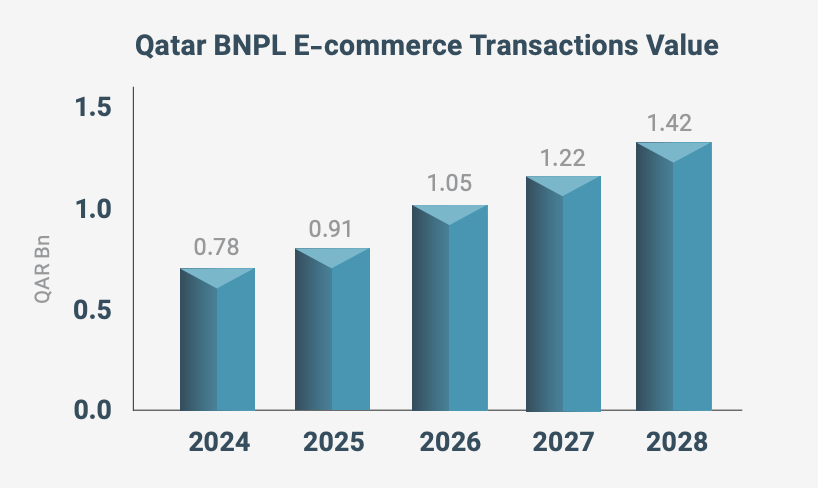
Buy now, pay later remains small. The segment is projected to grow at a 16% CAGR from QAR 1.05 billion in 2026 to QAR 1.42 billion (US$389.7 million) by 2028, when it would capture roughly 5% of e-commerce payments. Providers operate under Qatar Central Bank rules that took effect on 6 August 2023. At least two are licensed: PayLater and Tamanna.
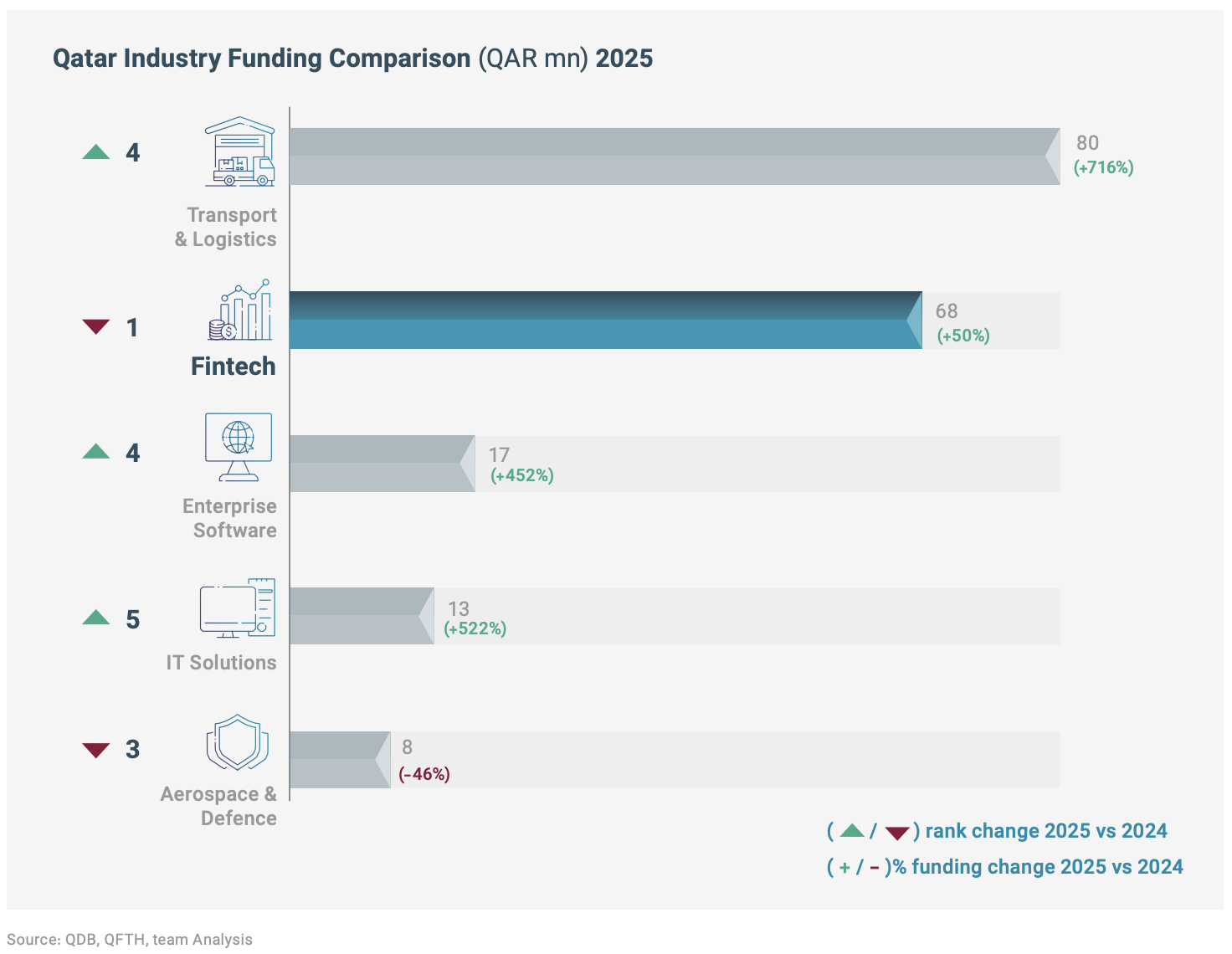
Fintech has become one of Qatar's larger startup categories. It was the second most active venture sector in 2025, with 11 deals accounting for 33% of all transactions, up from a 24% share in 2024. Funding reached QAR 68 million (US$18.7 million), a 50% increase on the previous year. Invest Qatar points to strong investor interest in regulated, infrastructure-focused business models and in digital finance ecosystems more broadly.
The recent checks bear that out. PayLater raised a US$10 million seed round in January 2026, SkipCash a US$4 million Series A in February, and GRO Solutions a US$600,000 pre-seed in July.
What the forecast describes is a market where the front end and the back end are being pulled apart. Banks keep clearing and processing; licensed non-banks hold the merchant relationship through gateways, terminals, links and wallets. Two things blur that line, and both are regulatory: direct connections to NAPS and QPay of the sort SADAD runs, and sandbox approvals of the sort Dibsy obtained in 2025. How far the Qatar Central Bank lets non-banks extend into settlement and checkout credit over the next two years will shape who captures the QAR 28 billion of added payment value the projections put on the table.


