etisalat's Nine-Month Profit Hits AED17.2 Billion After Vodafone Exit
Revenue rises 10% to AED57.6 billion while a near-AED8 billion gain from the Vodafone stake sale lifts reported profit; group subscribers climb to 254.8 million.

Abu Dhabi's etisalat booked a record AED17.2 billion in consolidated net profit for the first three quarters of 2026, 45.9% higher than the AED11.8 billion reported a year earlier. Revenue for the nine months rose 10% to AED57.6 billion, from AED52.4 billion.
One transaction explains most of it. The group sold its entire Vodafone stake during the third quarter, a disposal that contributed roughly AED8 billion. Total consideration, including the final dividend, reached AED21.9 billion. Strip the gain out and nine-month net profit was AED9.2 billion, or AED1.06 a share. The reported figure was AED1.98 a share, against AED1.36 in 2025.
Because the sale closed inside the quarter, nearly all of that gain lands in the three-month numbers rather than spreading evenly across the year. The figures were announced on 27 October, with comparatives set against the same periods of 2025.
The quarter on its own
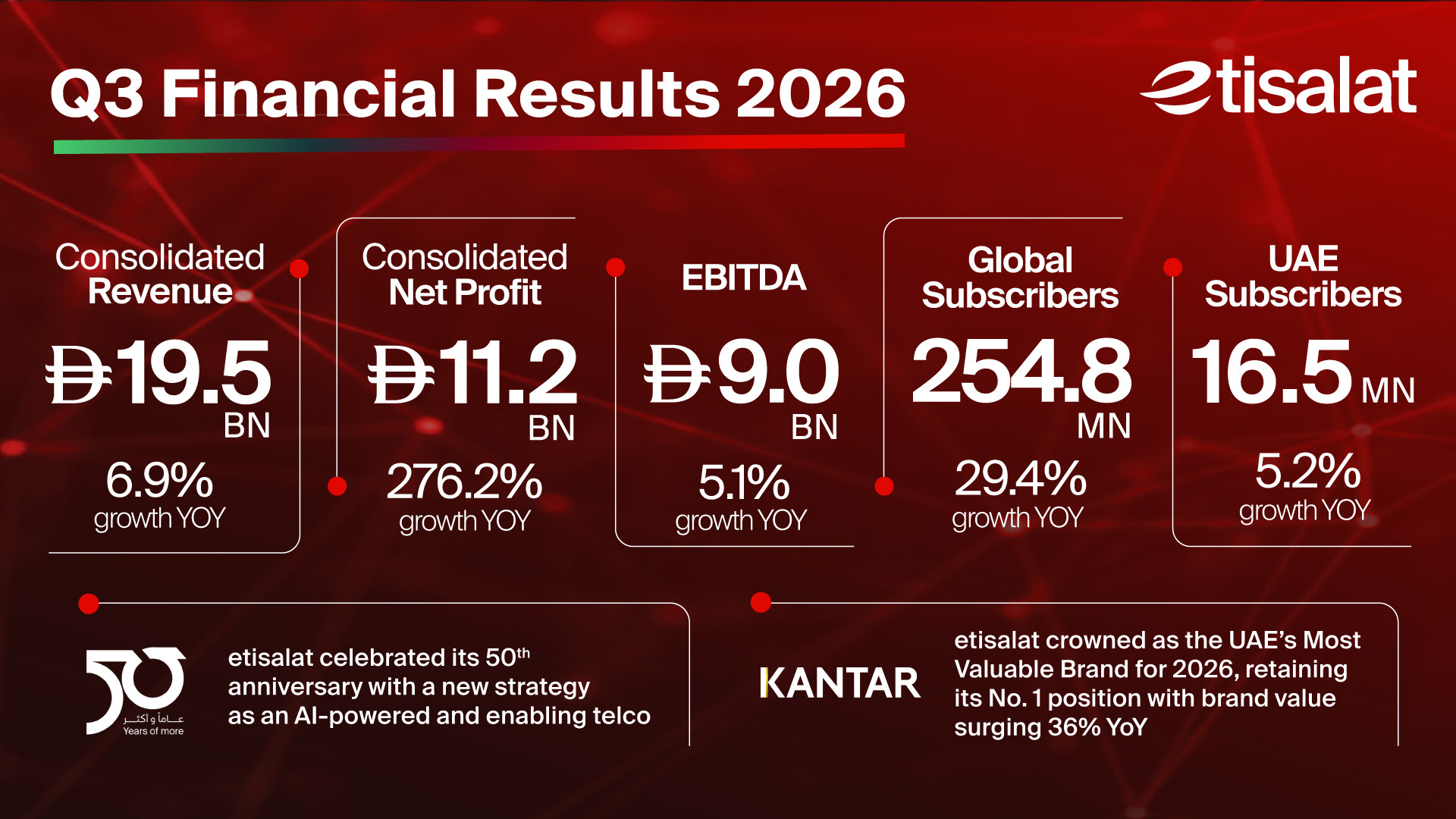
Third-quarter net profit reached AED11.2 billion, up 276.2% from AED3.0 billion a year earlier. Without the Vodafone gain it was AED3.2 billion, with earnings per share of AED0.37. Reported quarterly earnings per share moved from AED0.34 to AED1.29.
Revenue for July to September came in at AED19.5 billion, 6.9% above the AED18.2 billion recorded a year earlier. Across the nine months the increase was 10%, from AED52.4 billion to AED57.6 billion. Growth in the quarter therefore ran below the year-to-date average.
EBITDA for the quarter rose 5.1% to AED9.0 billion from AED8.5 billion. Over nine months it climbed 10.3% to AED26.7 billion from AED24.2 billion, a margin of 46.4%.
That margin leaves room to fund network spending out of operations rather than out of the sale proceeds: AED26.7 billion of EBITDA against AED57.6 billion of revenue is a little under half of every dirham collected.
Customers arrive faster than revenue
Subscriber numbers grew well ahead of sales. Total group subscribers rose from 197.0 million to 254.8 million, a 29.4% increase. The UAE base expanded 5.2%, from 15.7 million to 16.5 million.
Group CEO Masood M. Sharif Mahmood described a portfolio built across AI, cloud computing, cybersecurity, digital services and fintech. AI is being integrated more deeply into enterprise and government operations, he said, which makes foundational connectivity, compute and secure infrastructure more critical than it was. The group, he added, will keep providing that infrastructure and ultra-fast connectivity.
500 terabits by 2030
International connectivity capacity is due to pass 500 terabits per second by 2030, more than 25 times the current level. Additional routes are planned to make connections more efficient and reliable.
etisalat is marking its 50th anniversary, a year that also brought the Vodafone exit and a capacity plan stretching to 2030. The group is moving forward under the etisalat name with a strategy centred on artificial intelligence, connectivity and digital infrastructure.
The disposal changes the shape of the balance sheet as much as the income statement. A minority holding in a European carrier has become cash, and cash is what a capacity programme running to 2030 will consume. Strip out the gain and nine months of trading produced AED9.2 billion — a large sum, but the one that future periods will be measured against without a sale to help them.
Customer growth sits mostly away from the home market as well. The UAE's 16.5 million subscribers are a small fraction of the group total, so the international operations carried most of the 29.4% increase. For a business selling connectivity, compute and secure infrastructure, that mix decides where capital spending and regulatory risk actually sit.


