Gulf SMEs and AI: Adoption Hinges on Trust, Not Sophistication
Sovereign AI strategies dominate the headlines, but for the Gulf's small businesses adoption turns on trust, thin teams and tools that fit how they already work.
Anecdoted Desk Anecdoted Desk covers rolling funding rounds and startup news across the UAE and MENA -- the wire for deals as they're announced. team@anecdoted.com
The AI conversation in the UAE is dominated by sovereign strategies, enterprise transformation programmes and ministries preparing to put agentic AI into half of federal services within two years. That is a real story. It is not the one that explains how most Gulf businesses are actually changing.
SMEs make up 94% of businesses in the UAE, according to the Ministry of Economy. They get a small share of the attention.
The readiness gap
A 2025 study of 315 respondents at UAE hospitality SMEs found that backing from top management was among the strongest predictors of intent to adopt AI, alongside competitive pressure and government regulation. All three carried more weight than how useful the technology was perceived to be.
So the question is less whether the software works than whether anyone inside the business trusts it enough to push for it, and has the hours to spare. A restaurant owner running three venues on a thin back-office team has no use for an analytics suite that needs a dedicated administrator.
In field research with food and beverage merchants, operators described software in terms of risk rather than features: fast checkout, easy menu setup, minimal training, dependable support, clear pricing.
POS systems are chosen to minimise risk, not to maximise features.
Enterprise products are built around breadth of capability. Small merchants care whether the thing makes the day easier or harder, and AI adapted from enterprise software tends to demand what they lack: IT staff, lengthy onboarding, patience for features aimed at problems they do not have.
Where adoption is already happening
On the customer side, buyers are moving ahead of merchants. A 2026 shopping survey by Tabby, covering more than 20,000 respondents in the UAE and Saudi Arabia, found 43% use AI to help decide what to buy. Among 18- to 29-year-olds, 51.8% have used it somewhere in the shopping journey. Trust lags: only 30% fully trust AI recommendations.
Merchants' own experiments cluster around a narrow set of tasks. Those we studied had picked up ChatGPT, Gemini and DeepSeek mostly for marketing — social captions, campaign ideas, product names — and for pricing questions such as what to charge for a new item or how to structure a bundle and a discount. A few were testing AI-generated product images. Almost none had tried sales analytics or forecasting, which is partly a limitation of the tools: a standalone assistant cannot see a merchant's sales and operational data, so it has little to say about performance.
Operations pose a separate challenge. Staffing and inventory planning in UAE retail and hospitality are complicated by employment costs, visa requirements and seasonal swings in demand. Forecasting, reordering and shift planning are within reach of modest systems. They are not what merchants ask for.
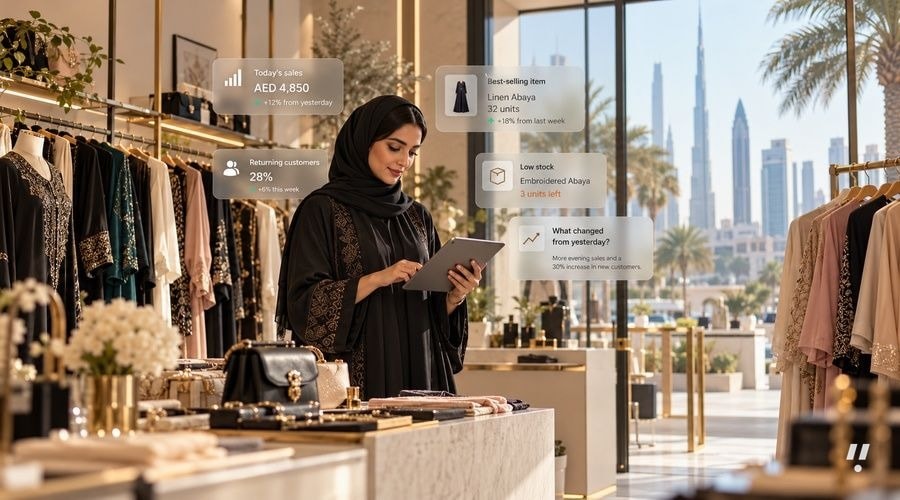
They want fast answers: today's sales, what changed since yesterday, what is selling best, whether anything looks unusual, whether they are on track, who sold the most, which customers came back.
Tell me what's happening in my business right now.
That request came up more often than any other.
Why the gap will widen
McKinsey's 2025 State of AI report found that organisations it classed as AI high performers, about 6% of respondents, were three times as likely as peers to report strong senior leadership ownership of and commitment to AI. They were also further along in scaling it. Those respondents are not Gulf SMEs, but the lesson travels: buying tools and extracting value from them are separate activities.
A restaurant that can see a slow Tuesday coming, or a retailer that can spot customers who have stopped returning, will run leaner than a competitor deciding by hand. In categories with thin margins, that advantage compounds.
Getting there needs tools shaped around thin teams, tight margins and no appetite for a six-month rollout — not a cut-down version of a platform built for a 500-person enterprise. The place to start is the merchant's own data, delivered immediately and legibly. Reliable answers about today, before anyone is asked to trust a forecast about next week.

