TECOM Group Revenue Rises 11% to AED2.3 Billion in First Nine Months
Occupancy of 97% and growth in every leasing segment lifted the Dubai business-district operator, with land lease revenue climbing 26%.

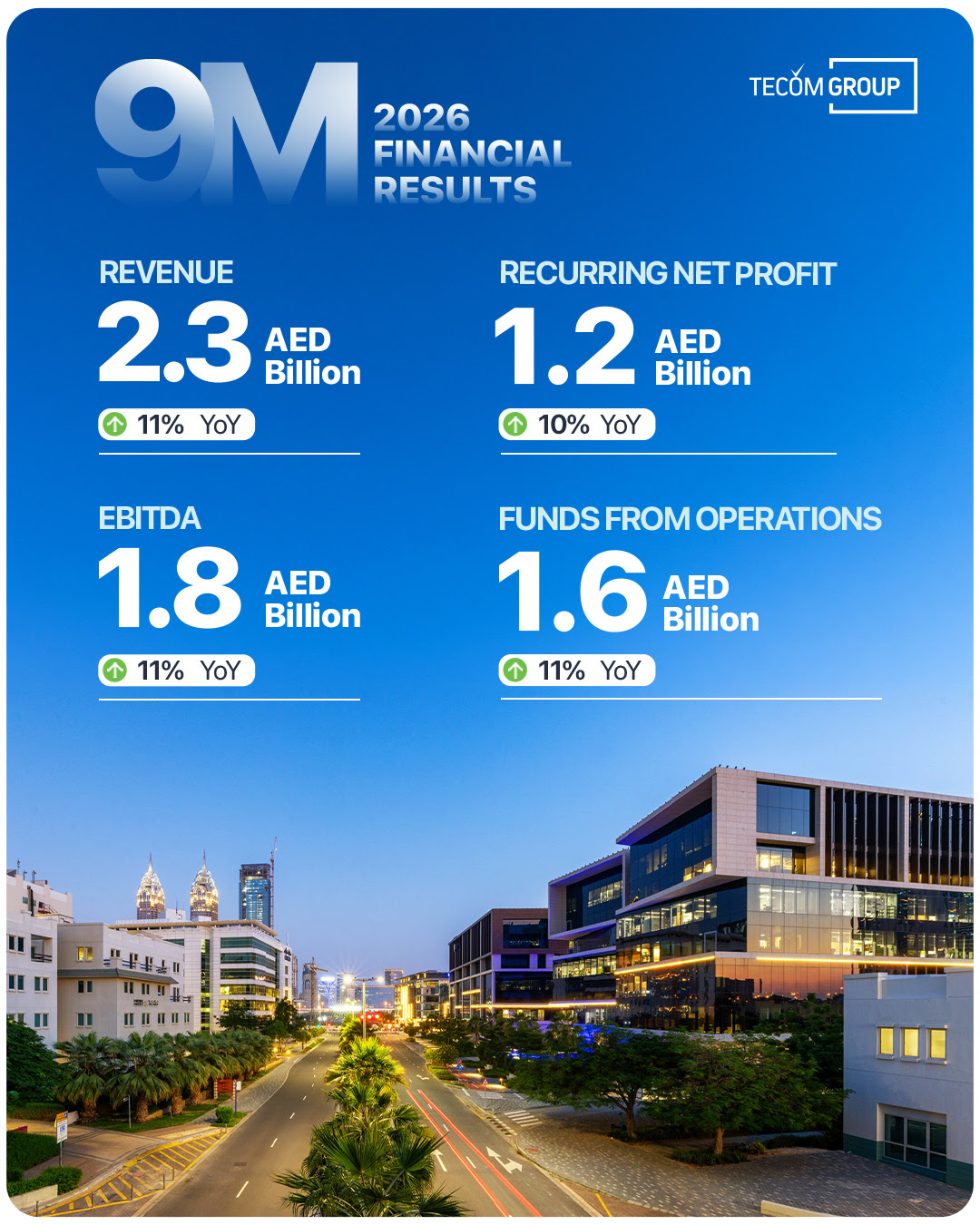
TECOM Group lifted revenue 11% to AED2.3 billion in the nine months to the end of September 2026, with every leasing segment contributing to the gain. The company owns and operates 10 specialised business districts in Dubai, and held portfolio occupancy at 97% while adding leasable space.
Commercial assets, the largest of the three revenue lines, generated AED1.2 billion, up 10%. Demand for Grade A offices and a bigger rentable footprint drove the increase, and the segment supplies more than half of group turnover. Industrial assets brought in AED365 million, a 13% rise. Land leases grew fastest, climbing 26% to AED563 million.
Recurring net profit advanced 10% to AED1.2 billion. EBITDA rose 11% to AED1.8 billion, a margin of 79%. Funds from operations, a cash-based gauge that property landlords use to track the income their buildings actually throw off, increased at the same rate to AED1.6 billion. Customer retention improved to 95% from 93% a year earlier.
Abdulla Belhoul, the group's chief executive, said the results showed firm appetite across a diversified portfolio, with growth balanced between asset classes. He credited the expansion of the industrial land lease portfolio with accelerating revenue growth in the third quarter, and cited high occupancy and retention rates as supports.
Third-quarter revenue rose 12% to AED809 million from AED724 million a year earlier, a faster pace than the nine-month average. Land lease income did most of the work, up 35% to AED202 million, and stood as the main driver of the quarterly increase. Commercial revenue added 6% to AED390 million. Industrial assets contributed AED125 million, up 11%. Recurring net profit for the quarter climbed 12% to AED417 million from AED373 million, while EBITDA reached AED627 million, an 11% gain, at a margin of 78%.
Belhoul said the group would keep strengthening its asset portfolio and pursue expansion in key sectors and future-focused industries, a strategy he said is aimed at creating long-term, sustainable value for shareholders.
Land leases now rank second to commercial assets by size, and their 26% growth rate sits well ahead of the 10% recorded by the larger commercial book. The 79% margin across the group reflects a portfolio where rental income arrives with little incremental operating cost, and retention of 95%, two points higher than a year earlier, makes that stream more predictable. At 97% occupancy there is little slack left to fill, which pushes the burden of further growth onto new space rather than empty units. TECOM's answer has been to keep building: increased leasable space supported commercial revenue in the period, and Belhoul's comments point to more of the same.


