AWS Sets December 2026 Launch for Saudi Cloud Region, $5.3B Investment
The Riyadh region takes AWS to 40 global regions and ties into HUMAIN's AI zone.
Nadia Mansour Nadia Mansour covers fintech across the UAE and MENA for Anecdoted -- digital banking, payments licences and the startups building around them. nadia@anecdoted.com
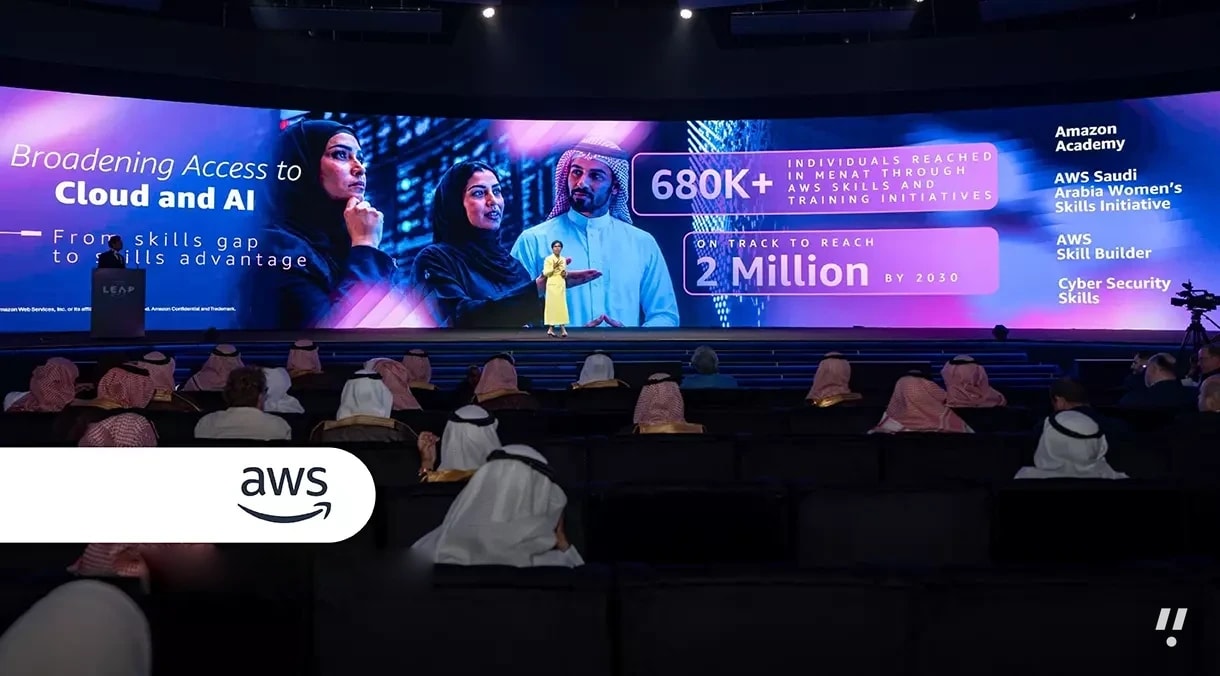
At the LEAP conference in Riyadh, AWS disclosed that its first cloud infrastructure region in Saudi Arabia will open in December 2026. The plan was first announced two years earlier, in March 2024. The company is putting more than US$5.3 billion behind the region. When it goes live, AWS will be running 40 regions globally.
That same event brought a deeper tie-up with HUMAIN, a Public Investment Fund-owned company. AWS will commit up to 50 megawatts of capacity to Saudi Arabia's first AI Zone by 2028, and the zone will use AWS's Trainium chips. NVIDIA infrastructure will also be present for AI training and inference.
The HUMAIN relationship reaches into AWS's catalog, too. ALLAM, the Arabic-language model HUMAIN built, will become available through Amazon Bedrock. HUMAIN Fabric, the company's AI-native data platform, is set to be listed on AWS Marketplace.
AWS says every one of its regions, this one included, is "sovereign-by-design." CEO Matt Garman said the launch will deliver full-stack cloud and AI infrastructure, with the intent of creating new industries and jobs while advancing Vision 2030 goals. Minister of Communications and Information Technology Abdullah Alswaha said the expanded partnership bolsters the kingdom's standing as a global computing hub. Those two quotes frame the project in very different ways — one focused on what AWS will sell, the other on what the country will become.
The economic opportunity is large. Research AWS commissioned from IDC suggests AI could contribute US$130 billion to Saudi Arabia's economy by 2030. Local businesses are already using AWS for AI workloads: Abdul Latif Jameel, Almosafer, and stc Group were named as active examples.
AWS's broader Middle East strategy needs a work force to match. Amazon Academy, created with the Ministry of Communications and Information Technology, has a target of training more than 100,000 Saudi citizens for digital careers, including a skills track for 10,000 women. AWS says it has already trained more than 680,000 people across the Middle East, North Africa, and Turkey, and wants to reach two million by 2030.
The timing matters for more than infrastructure. With the region landing in 2026 and the AI Zone arriving by 2028, AWS and HUMAIN have a two-year runway to connect data centers, chips, and language models before the heaviest demand hits. The sovereign-by-design framing, combined with HUMAIN's PIF ownership, gives Riyadh a way to claim this cloud capacity as national infrastructure. That argument is aimed inward at regulators and outward at customers who treat data residency as a compliance requirement. It is also a signal, in a crowded Gulf AI market, that the kingdom intends to host its own core computing rather than rent it from elsewhere.

