Maersk, Hapag-Lloyd Move AE19 Service Back Through Suez Canal
The carriers are shifting the Asia-Europe service from the Cape of Good Hope to Suez after security assessments.
Tariq Benali Tariq Benali covers business and corporate news across the UAE and MENA for Anecdoted, tracking the deals, leadership moves and regulatory shifts behind the region's companies. tariq@anecdoted.com
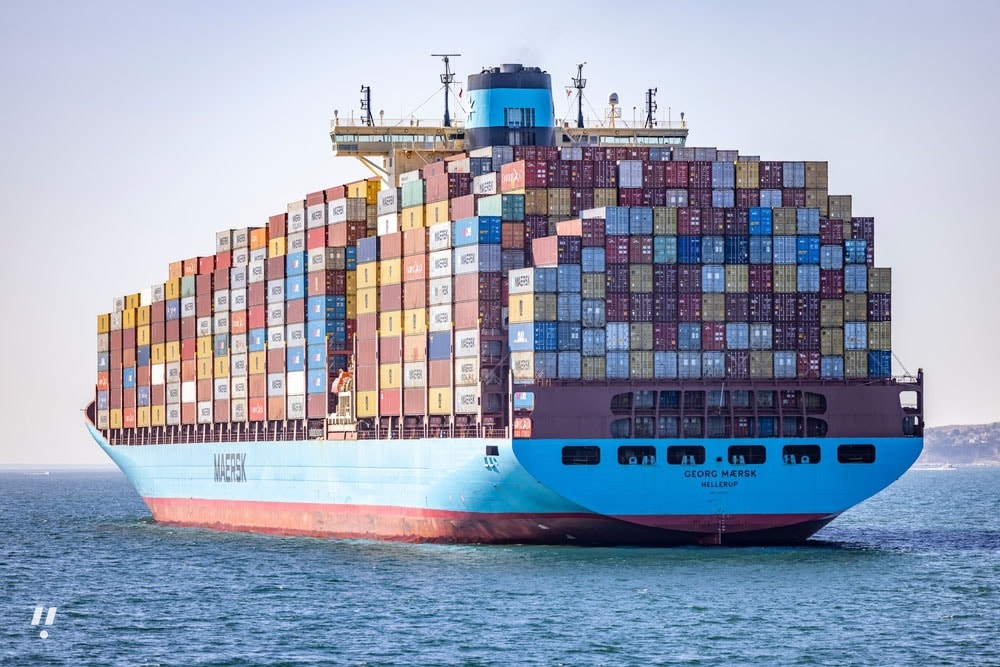
Maersk and Hapag-Lloyd will reroute their AE19 service through the Suez Canal. The shift away from the Cape of Good Hope was announced Monday, after the two carriers completed security assessments of the Red Sea area. AE19 connects Asia, the Mediterranean, Saudi Arabia, and Europe on one loop.
The change begins with Berlin Maersk’s westbound voyage 628W and eastbound voyage 637E. The new AE19 rotation includes a call at Jeddah and a transit of the Suez Canal. After Suez, the service continues to Port Said and Tangier. The eastbound journey retraces the same route through the canal. Jeddah is the Saudi Arabian stop on the rotation, which gives the service a Red Sea link connecting Asia, Europe, and the Middle East.
The rotation has a straightforward shape in practice: Asia to Jeddah, through the Suez Canal into the Mediterranean, then to Port Said and Tangier. On the way back, the vessel crosses the Mediterranean, passes through the Suez Canal again, and turns toward Asia. This makes two Suez transits on each full round voyage.
Maersk described the Suez and Red Sea corridor as the fastest, most sustainable, and most efficient option for Asia-Europe transport. The structural change, the company said, will give customers more efficient transit times. Maersk and Hapag-Lloyd said they will keep assessing their network for optimization. For now, there are no plans to change other Gemini services.
This is the second Gemini service to move in this direction. In early July, the two lines announced that their AE15 Gemini service would resume sailing through the Suez Canal. That decision was described as a step toward a gradual return to the trans-Suez corridor. Maersk added a call at Jeddah to AE15 after it returned to Suez. Further Gemini service changes, Maersk said, would depend on Red Sea stability.
The background is important. Global shipping lines have avoided the Suez and Red Sea route for years because of Houthi attacks. They diverted their fleets around the Cape of Good Hope, a much longer voyage around the southern tip of Africa. Maersk and Hapag-Lloyd launched the Gemini network in 2025 with Cape of Good Hope routings for that reason. The two carriers maintained plans to return to a Suez-based network when security conditions allowed. The AE19 move is consistent with that plan, but it is not an open-door signal.
Maersk was explicit about that. The AE19 move does not signal a wider shift of its East-West network back to the trans-Suez corridor. There is no specific timeline for a broader move. The rest of the Gemini network is still being assessed service by service. Schedules remain conditional on security conditions in the Red Sea.
The effect on shippers is more gradual. One more service is back on the shorter Suez route between Asia and Europe, but the Cape route still carries most of the Gemini network. Carriers are treating each loop separately, moving a service back only after a security review supports the change. The next service to shift will depend on Red Sea stability and on whether the partners decide another loop is ready to follow AE15 and AE19.

