Oro Raises $3M for DeFi That Understands Plain Language
The Dubai-based platform has raised a strategic round and plans to grow from 350,000 to 10 million active users.
Nadia Mansour Nadia Mansour covers fintech across the UAE and MENA for Anecdoted -- digital banking, payments licences and the startups building around them. nadia@anecdoted.com
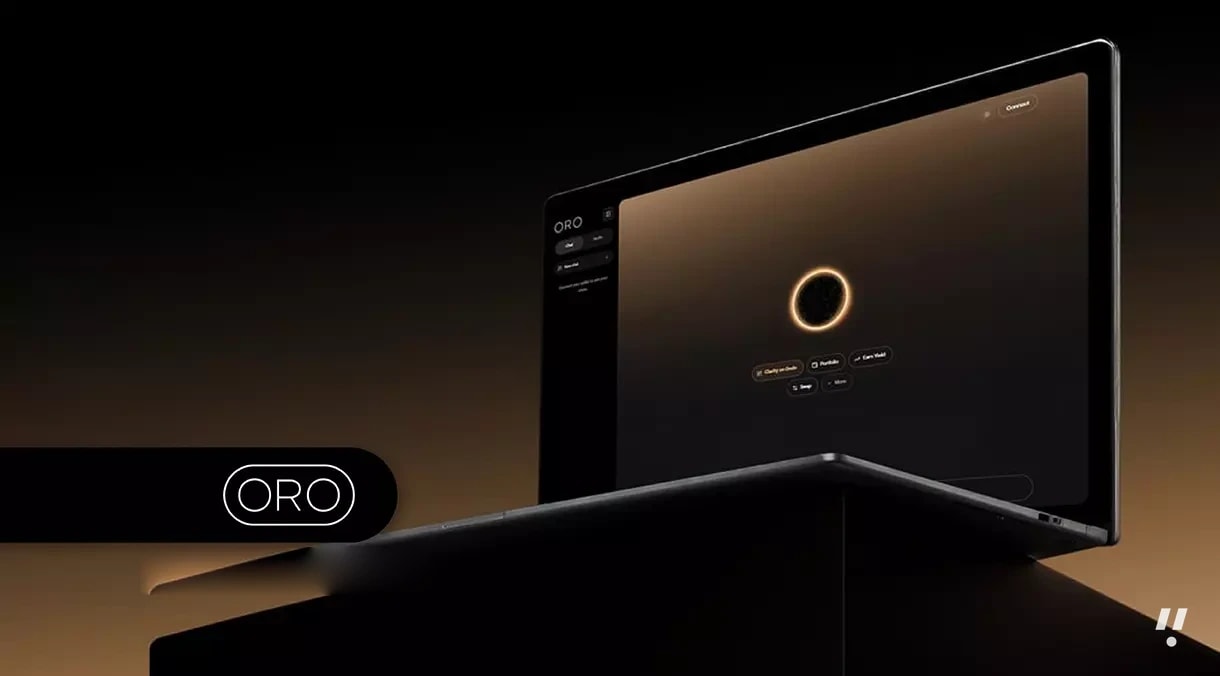
Oro, a Dubai-based financial AI platform, has closed a US$3 million strategic funding round. The round brings Oro's total capital raised to US$4 million. MH Ventures and Mapleblock Capital co-led the deal. M2M Capital, Archer Capital, and X21 Digital joined as participants, while Disrupt.com and ZIGLabs provided follow-on backing. The company was founded in December 2024 by Varun Choudhary, who serves as co-founder and CEO.
Oro's core idea is to let users describe financial goals in plain language rather than specifying individual transactions. Its AI converts those goals into multi-step DeFi transactions, selecting an execution path across the protocols it has integrated. The user reviews and signs each transaction. Each step in the sequence requires explicit approval. Every execution is non-custodial, so Oro never takes control of user funds.
That design makes the platform an "intent-based" system. For Oro, intent-based execution is not a roadmap item; it is the core of the product. Choudhary said the industry is seeing a monumental shift toward intent-based execution. He framed the funding round as proof that product-market fit, not marketing, is what attracts institutional capital.
Oro reports more than 350,000 active users and support for over 80 languages. An AWS-backed educational campaign drove over 250,000 verified user completions. An Ondo Finance initiative produced over 50,000 completions in its first 24 hours. The rapid completion rate from the Ondo initiative suggests the product is able to convert educational interest into active usage. The campaigns have become a channel for user acquisition.
Live integrations with Morpho, Kamino, Lido, Aave, Uniswap, and Raydium allow Oro to route user intents across lending, staking, and trading venues. The platform decides which of those venues best suits a given goal, then assembles the necessary steps. Those protocols were chosen to give Oro coverage across the main DeFi primitives: lending, liquid staking, and exchange.
The new capital will go to four areas: expanding its Shield Engine, expanding natural-language execution technology, scaling global marketing and user acquisition, and building regulatory and compliance frameworks around policy-guarded autonomous custody. The policy-guarded piece is meant to let the AI operate within clear legal boundaries while still maintaining non-custodial control. Oro also plans to grow its engineering and business development teams.
Looking ahead, Oro wants to reach 10 million active users in 6 to 12 months, a roughly 28-fold increase. The roadmap includes native iOS and Android apps, a broader set of integrations, and a plan to function as a routing layer for intent-based transactions across the wider DeFi ecosystem.
Keira Nesdale, portfolio manager at MH Ventures, said complexity is one of the most persistent bottlenecks in modern finance. She said Oro is uniquely positioned to lead the agentic finance transition. Agentic finance, in this context, refers to systems that act on behalf of users with some degree of autonomy. Oro's user-signed transactions keep that autonomy bounded: the AI proposes, the user disposes.
The strategic backing from infrastructure-focused investors points to a shift in DeFi competition: usability and intent interpretation are becoming as important as raw execution. Oro's non-custodial, user-signed model also raises a question for regulators: if an AI acts on a user's behalf, who is responsible when something goes wrong?

