UAE Leads World on SME Support as Gulf Gains Outpace Global Trend
The UAE takes first place for financial-system backing of small-business growth and 21st overall, while Saudi Arabia's government-support gains lift it to 27th.

The UAE ranks first in the world for the extent to which its financial system supports small and medium-sized business growth, scoring 96.4 in the 2026 Global Financial Inclusion Index. Saudi Arabia sits second on that measure at 95.2.
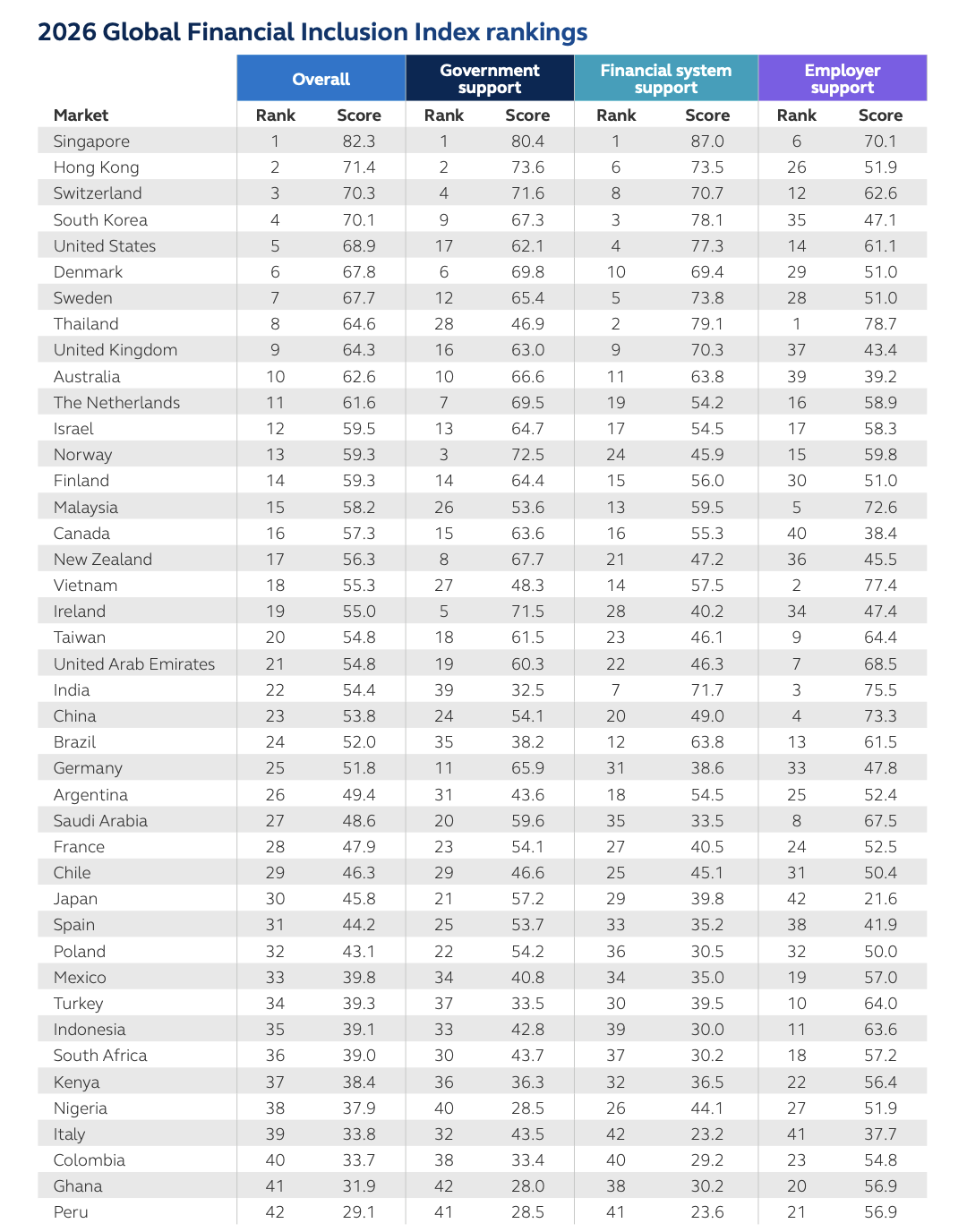
The index, compiled by Principal Financial Group with the economics research firm Cebr, scores 42 markets across three areas: government support, financial-system support and employer support. The UAE placed 21st overall, one position higher than the previous year. Saudi Arabia rose three places to 27th.
Government support did most of the lifting this time. Scores on that measure climbed 1.4 points in the UAE and 5.1 points in Saudi Arabia, driving both countries' overall advances. Twelve months earlier, the region's improvement had come mainly from the financial system rather than from public policy.
That shift runs against the wider picture. Globally, people's views of how far financial systems help business confidence and SME growth weakened. Both Gulf markets moved the other way, and the two countries sit inside the top five worldwide on public sentiment about inclusion.
"The UAE and Saudi Arabia have paired digitisation with visible changes in government and financial system support, and people are noticing." — Charles Brooke, Principal Asset Management
The UAE ranked seventh for employer support, scoring 68.5 against a global average of 65.7. Employer support declined worldwide for a second consecutive year.
National fintech strategies were assessed separately. Saudi Arabia scored 20 out of 20, the highest of any market, and was named one of five "Next Gen Leaders". The UAE was designated a "Quantum Leaper" for its progress in digital financial infrastructure.
The headline numbers show how much distance remains. The global inclusion score reached a record 52 out of 100, yet public perceptions of inclusion fell to the lowest level recorded. Systems can score well while the people using them feel less served. The Gulf results point to where that gap narrows: policy and digital infrastructure moving together, with the benefit visible enough for residents to register it.


