Uber Riders in Dubai Can Now Hail Baidu's Driverless Apollo Go
Starting August 20, Dubai Uber riders can be matched with Baidu's fully driverless Apollo Go robotaxis in selected neighborhoods.
Karim El-Sayed Karim El-Sayed covers company news, policy and regulation across the UAE and wider MENA for Anecdoted, with a focus on how new rules and licences reshape how startups operate. karim@anecdoted.com
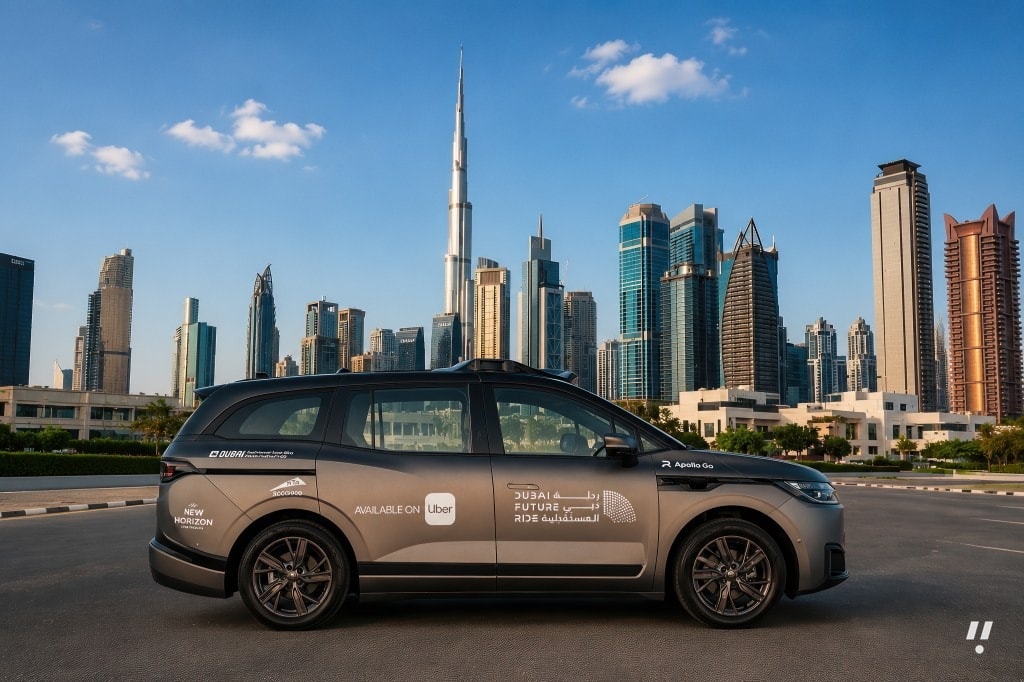
Uber Technologies has put Baidu's fully driverless Apollo Go vehicles on its platform in Dubai, giving riders a new driverless option alongside human-driven cars. Starting August 20, anyone who requests UberX or Uber Comfort in Dubai may be matched with an Apollo Go robotaxi. Riders can select an 'Autonomous' option in the Uber app to increase the chance of being matched with one, though it is not a guarantee. Uber described the launch as the first time its multi-partner autonomous vehicle strategy operates on public roads.
Sarfraz Maredia, Uber's global head of autonomous, said bringing the partnership with Baidu to life is a major step forward in expanding autonomous mobility globally. He added that Dubai marks the first city where Uber's multi-partner vision runs on public roads. New Horizon Luxury Transport will act as the fleet operator for the Apollo Go service in Dubai.
The initial service area covers selected parts of Umm Suqeim and Jumeirah. Riders there may be matched with the driverless cars when they request a trip. Uber and Baidu plan to expand the operating area in a later phase.
The robotaxis are Apollo Go's sixth-generation RT6, a fully electric vehicle designed for driverless operations. Each RT6 carries up to three passengers. More than 30 sensors give the car environmental perception and onboard data processing, allowing it to handle the trip without a human driver.
Nan Yang, Baidu's vice president and general manager of its overseas Intelligent Driving Group, said Dubai is the first city where Baidu has established a dual model internationally. Baidu will offer self-operated autonomous ride-hailing and partner-based autonomous ride-hailing at the same time. Yang said this gives Dubai riders another way to use autonomous mobility.
Apollo Go currently operates in 28 cities. Its fleet has covered more than 350 million autonomous kilometers, including more than 240 million fully driverless kilometers. Uber requires all autonomous vehicles on its network, including Apollo Go, to meet its safety guidelines before they are deployed.
Uber's safety requirement adds a second layer of review to the rollout. Apollo Go's record in other cities does not exempt the RT6 from Uber's guidelines. Every autonomous vehicle on Uber's network has to meet those standards before it can carry riders.
The launch is bigger than a new robotaxi in one city. Uber is building a network where many autonomous vehicle companies can offer rides, and Dubai is the first place where that multi-partner model operates on public roads. For Baidu, the dual model creates a direct comparison between running its own service and relying on a partner such as New Horizon Luxury Transport. Apollo Go has built most of its mileage in China; Dubai tests whether that experience transfers to another platform and another market. The result will help determine how quickly Uber adds more robotaxi makers and how Baidu expands beyond the cities where it already operates.

