Agentic Commerce Interest Rises in the Middle East as Adoption Stays Early
Few organizations in the UAE and Egypt have deployed autonomous purchasing, but many plan pilots and budget increases within two years.
Nadia Mansour Nadia Mansour covers fintech across the UAE and MENA for Anecdoted -- digital banking, payments licences and the startups building around them. nadia@anecdoted.com
Agentic commerce is still young in the Middle East, but the appetite for it is climbing quickly. A study of senior leaders in retail, consumer products, travel and hospitality, and financial services across the UAE, Egypt and Saudi Arabia found that most organizations intend to spend as much as US$1 million on AI within the next 24 months.
Deployment is rare, exploration is not
Only 2.4% of Egyptian organizations have rolled out autonomous purchasing, covering auto-reordering and autonomous buys, across the whole business. Another 32.2% are weighing such tools with no fixed schedule. The UAE is slightly further along: 2.9% have fully implemented agentic AI, while 35.2% are exploring it without set dates.
Near-term plans say more. In Egypt, 16.1% expect to run pilots within six months and a further 16.1% have sketched mid-term rollouts. In the UAE, 29.3% have fixed timelines: 11.7% aim to pilot within six months and 17.6% plan implementation over one to three years.
Why organizations want it
Revenue growth is the leading motive in both markets, named by 26.6% of Egyptian respondents and 27.7% of those in the UAE. Customer loyalty and retention rank second, at 20% in Egypt and 33.3% in the UAE, followed by operational efficiency at 20% and 11.1%. Market differentiation (13.3% in Egypt, 5.5% in the UAE) and customer acquisition (13.3% and 16.6%) round out the list.
Budgets shift from trials to strategy
Most organizations have redirected or topped up budgets for new AI technologies. More than a third in both countries devote 1% to 4% of annual budgets to AI, while 25.8% in Egypt and 26.4% in the UAE commit 5% to 10%. A smaller group goes further: 6.4% in Egypt and 8.8% in the UAE spend above 10%.
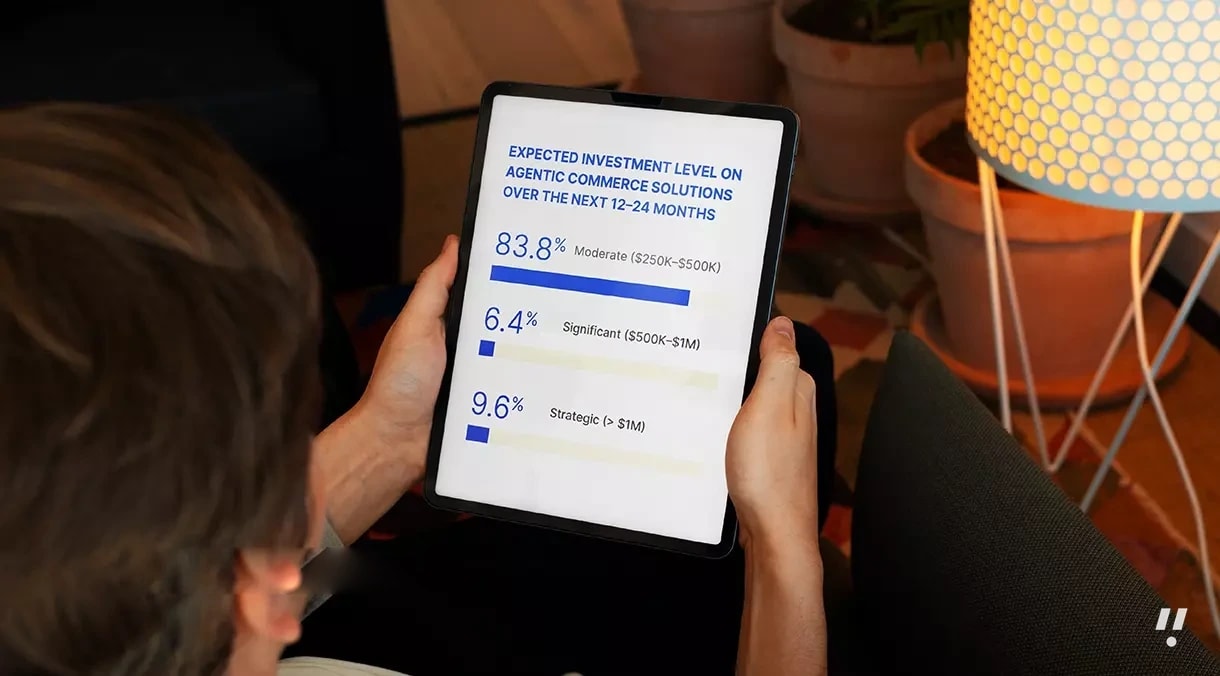
Planned spending on agentic commerce over the next 12 to 24 months diverges. In the UAE, 17.6% expect to invest more than US$1 million and 41.1% between US$500,000 and US$1 million. Egypt is more restrained: 9.6% plan to exceed US$1 million and 6.4% to spend between US$500,000 and US$1 million, with 83.8% targeting US$250,000 to US$500,000.
Security and unclear returns hold adoption back
Data privacy and security are the top obstacles, cited by 24.5% of UAE respondents and 19.3% of Egyptian ones. Unclear return on investment follows, at 17.2% in Egypt and 13.7% in the UAE. Regulatory compliance worries 15% of Egyptian firms. In the UAE, 8.8% cite fear of losing brand control or customer relationships, and 7.8% point to reliance on outside vendors.
Payment infrastructure takes shape
The findings land alongside Visa's Agentic Ready program, launched in the UAE to help financial institutions prepare for agentic commerce. In its first phase, issuers can test and validate agent-initiated transactions inside a controlled setting built to mirror live production. Abu Dhabi Commercial Bank, Abu Dhabi Islamic Bank, Al Ansari Exchange, Emirates Islamic, Emirates NBD, Mashreq, Tabby, Wio and Ziina have joined.

