Dubai real GDP drops 2.3% to $128.8B in first half of 2026
Trade and transport pulled real output lower even as finance, healthcare and utilities expanded, while GDP at current prices edged up 0.2%.
Tariq Benali Tariq Benali covers business and corporate news across the UAE and MENA for Anecdoted, tracking the deals, leadership moves and regulatory shifts behind the region's companies. tariq@anecdoted.com
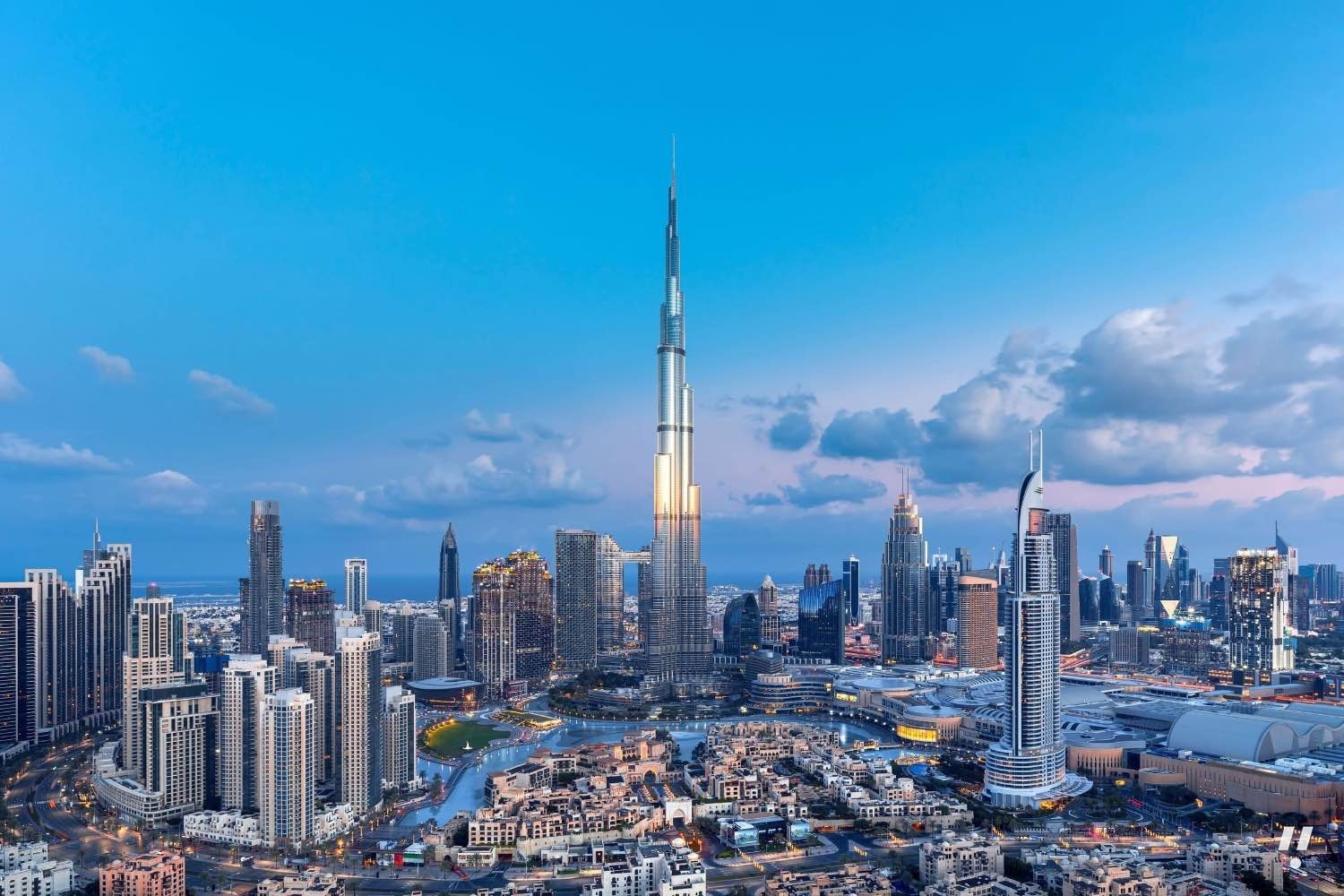
Dubai's real output fell 2.3% year on year in the first half of 2026, to $128.8 billion (AED 473 billion), from $131.8 billion (AED 484 billion) in the same six months of 2025, official statistics show.
At current prices the emirate still grew, just barely. GDP rose 0.2% to $137.5 billion (AED 505 billion), as expansion in finance, health and utilities outweighed contractions in trade and transport. Officials put the split result down to shifts in the global economy and said the breadth of Dubai's industrial base absorbed part of the shock.
Financial and insurance activities were the standout among large sectors, adding 8.8% in real terms. Value added climbed to $17.9 billion (AED 65.9 billion) from $16.5 billion (AED 60.6 billion), lifting the sector's share of real GDP to 14% from 12.5%.
Healthcare and social work posted the fastest growth of any sector at 14.3%. Electricity, gas, water supply and waste management followed at 5.4%, then government services at 2.9%, information and communication at 2.7%, construction at 2.4% and education at 1.2%.
The drag came from the two biggest pieces of the trading economy. Wholesale and retail trade shrank 6% in real terms even though its value added rose 2% at current prices and foreign trade expanded 4%. Transportation and storage fell 7.4%, leaving value added at $13.8 billion (AED 50.6 billion). Real estate contracted 2.5% in real terms while its current-price value added rose 5.4% to $17.7 billion (AED 65.1 billion). Manufacturing slipped 0.9%.
Trade remains the largest single contributor to real GDP at 20.5%. Financial and insurance activities account for 14%, real estate 11.8% and transportation and storage 10.7%.
Helal Saeed Almarri, director general of the Dubai Department of Economy and Tourism, said the half-year figures demonstrate "the strength and depth of Dubai's economic fundamentals" and pointed to year-on-year growth across strategic and future-focused sectors as evidence that the emirate's diversification push is holding. The government said it will keep backing established industries while drawing investment and talent into higher-value sectors.
the strength and depth of Dubai's economic fundamentals
Separately, Sheikh Mohammed bin Rashid Al Maktoum, UAE Vice President, Prime Minister and Ruler of Dubai, said last week that $571.8 billion (AED 2.1 trillion) of projects are under way across the emirate, which he described as an ideal destination for investment.
Real estate takes the largest slice: $299.5 billion (AED 1.1 trillion) through 2030, or 52.4% of the total. Aviation is next at $129.3 billion (AED 474.7 billion), or 22.6%, split between $34.9 billion (AED 128 billion) for Al Maktoum International, designed for up to 260 million passengers a year, $89.3 billion (AED 328 billion) for expanding the Emirates and flydubai fleets, and $5.1 billion (AED 18.7 billion) for a new Emirates engineering and maintenance complex.
Utilities take 12.4%: $41.1 billion (AED 151 billion) for new power and water grid capacity, $21.8 billion (AED 80 billion) for the Dubai Strategic Sewerage Tunnels and $8.2 billion (AED 30 billion) for the Tasreef rainwater drainage scheme. Road upgrades plus the Metro Blue and Gold lines are budgeted at $27.2 billion (AED 100 billion), or 4.8%, and the second phase of the Dubai International Financial Centre at more than $27.2 billion (AED 100 billion). The exhibition centre expansion carries $2.7 billion (AED 10 billion) and the Blue and Green Spaces Roadmap $1.1 billion (AED 4 billion).

