Fintech Forward 2026 Day 1: Stablecoins, Tokenization and AI Take the Stage
Opening day in Bahrain covered round-the-clock payment rails, tokenized assets, cross-border corridors and the governance of autonomous AI in finance.
Tariq Benali Tariq Benali covers business and corporate news across the UAE and MENA for Anecdoted, tracking the deals, leadership moves and regulatory shifts behind the region's companies. tariq@anecdoted.com
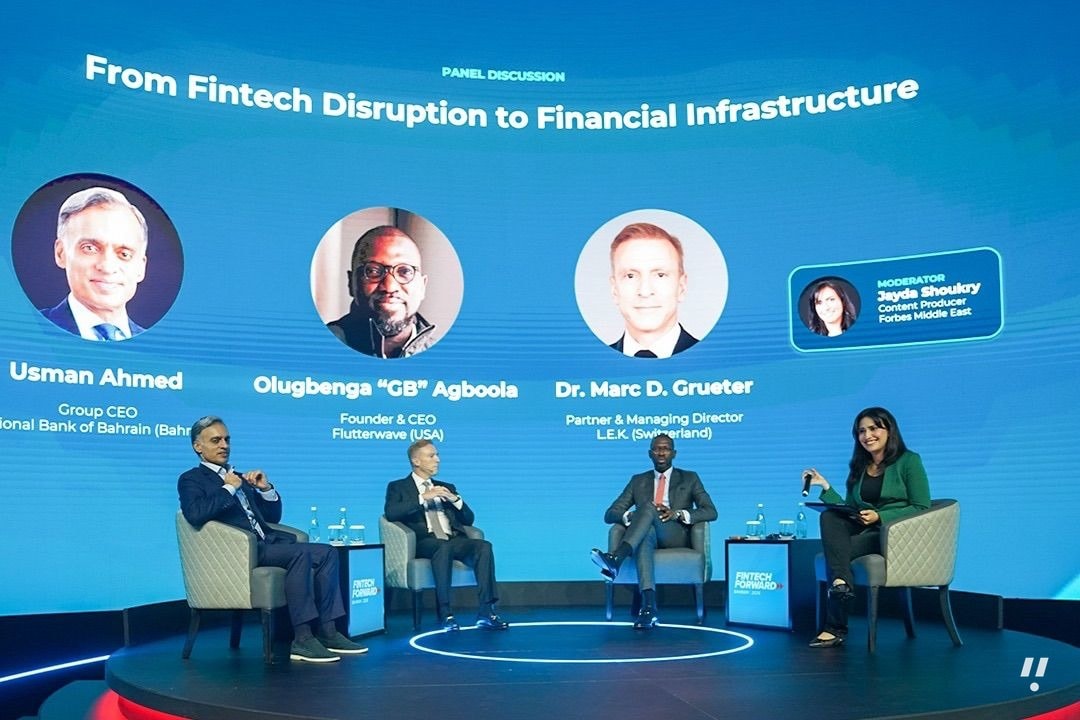
Stablecoins, tokenized assets, cross-border corridors and autonomous AI filled the opening day of Fintech Forward 2026 in Bahrain, as speakers worked through what banks, regulators and fintechs must settle before digital finance scales across the region.
Money that does not stop
Louis Liu Xi, founder and CEO of FOMO Pay, said financial hubs must be built for continuous settlement. Money no longer pauses overnight, and centres such as Bahrain, the wider Gulf and Singapore need rails that clear around the clock. Stablecoins, which he put at roughly $300 billion minted for circulation, can ease cross-border transfers. Within one to three years, he expects on-chain money to be buying on-chain assets.
Franz Bergmueller, CEO of Amina Bank AG, said lenders will run conventional and blockchain-based rails side by side. Their job shifts from operating payments to supplying trust, which puts compliance and reserve backing at the centre. Stablecoins still account for under 1% of global payment flows, he said, leaving room to grow.
For Miriam Kiwan, CEO for MEA and APAC at Confirmo, business-to-business cross-border payments are the clearest regional use case. The Gulf is not merely one link in the corridor, in her view; it is the corridor, given its remittance and trade volumes. She expects stablecoins to become unremarkable by 2029, to the point where the debate about them disappears.
Tokenized assets need plumbing
Ben El-Baz, head of international markets at HashKey Group and managing director of HashKey EMEA, said tokenized assets need deeper liquidity, wider distribution and more practical uses before adoption broadens. Cross-border payments remain the sharpest friction, with tokenized deposits and tokenized foreign exchange among the possible answers.
Henry Duckworth, founder and CEO of Agridex International, said settlement speed matters most in agricultural trade, where delays raise financing costs and put perishable cargo at risk. About 80% of prospective users who decline his company's product cite its inability to connect with existing banking and trade finance arrangements.
Xavier George, managing director of AXG Group and CEO of AX Coin, argued that banks should place an orchestration layer over current systems rather than replace them, linking to liquidity providers, stablecoin issuers and payment rails. He also called for tighter compliance and governance as automation spreads, describing a move from a nine-to-five settlement culture to round-the-clock operations across on-chain and off-chain venues.
Corridors, costs and agents
Ali Bailoun, senior vice president and group general manager for Saudi Arabia, Bahrain and Oman at Visa, said the priority is wiring global capability into local central bank systems while cutting backend friction. Customers should never see the complexity, he said.
Michelangelo Giacco, CEO of Ooredoo Fintech, said aligning rules across the region and permitting licence passporting are prerequisites for scaling. Within five years, he predicted, everyone will have one or more agents spending on their behalf, which pushes automated international settlement to the fore.
Mohamed Mansour, regional head of the Middle East at Wise, said digital-first models lower barriers to inclusion: digital onboarding can pull customer acquisition costs from $20 to $1.50. Direct access to central bank rails, he added, turns a costly international transfer into two domestic legs.
From football to finance
Louis Saha, the former France international who founded KiiMasters and AxisStars, said few athletes are ready for retirement, describing the loss of routine and purpose that follows a career's end. He drew on lessons from former Manchester United manager Sir Alex Ferguson about pairing discipline with empowerment, so players felt answerable for their own actions and successes. Saha warned against blind reliance on outside advisers and said young sports stars must act as their own CEOs. KiiMasters, he said, was built to make complex financial and personal guidance easier to reach while turning athletes' profiles toward wider impact. He pictured a future with 100 former athletes running companies, arguing that an icon's word carries far more weight.
Governing autonomous AI
Jacques Benhamou, chairman at JEMS, said banks need strict supervisory controls before actionable AI goes live, and that technology can be outsourced while accountability cannot. Mohamed Abdalmagd, senior big data and analytics manager at ila Bank, favoured a phased rollout: treat the agent as a new hire with a defined remit rather than handing it a master key, and build decision auditability into its architecture. Nilixa Devlukia, CEO of Payments Solved, focused on consumer protection and liability when agents act beyond what a user intended, calling for operational guardrails and transaction thresholds.
Özgür Kuru, global head of data and AI at Accelera Digital Group, said graph and vector databases are needed to establish behavioural baselines and catch synthetic identity networks. Bolting AI onto legacy architecture, he said, is like fitting an electric motor to a horse-drawn carriage; micro-segmentation can curb false positives. FAN Yang, CTO of digital finance for the Middle East and Central Asia at Huawei Technologies, said AI stops being an analytical tool and becomes critical infrastructure once it controls transaction blocks or payment routing, requiring real-time data foundations, fail-safes and systems built to fail from the outset. Nameer Khan, chairman of the MENA Fintech Association, said accountability, not technology, is the obstacle to autonomous finance, and urged institutions to redesign around AI with named human owners, trust and full audit trails for regulators.
The day closed with UK and Swiss fintech delegations presenting their technology and scouting collaboration with Bahrain's financial sector. Fintech Forward 2026 runs on 7-8 October, hosted by the Bahrain EDB with support from the Central Bank of Bahrain, the Labor Fund (Tamkeen), the Bahrain Tourism and Exhibitions Authority and Bahrain FinTech Bay.

