Nikita Kuzmin Built Helpster So Donors Can See Where a Gift Went
The Dubai-based entrepreneur behind Helpster Charity treats giving as a measurable operation: each case verified, each payment sent straight to a hospital, each donor able to follow the outcome.

Nikita Kuzmin posed himself a question about five years before he started a charity. If he put $10,000 into a $50 billion fund run by one of the large international organizations, what would change? His answer was nothing he could observe.
So he tried smaller groups instead. The Dubai-based entrepreneur wrote to small charitable organizations in Thailand, Indonesia and Vietnam and asked what they would do with a donation. Roughly 80 percent never wrote back. Some of those that did said to send the money and they would work out its use later.
A letter, and 80 percent silence
That silence is the reason Helpster Charity exists. Kuzmin founded it in 2022, arguing that charity is the only industry where 'trust me' still counts as an answer.
Helpster pays for urgent medical care for children, young adults and pregnant women in Kenya, Nigeria and Bangladesh, in communities where Kuzmin says free healthcare is not available. The money is narrow in its path by design: each payment goes straight to the hospital. Donors can follow the specific cases their funds supported through the organization's app.
The published numbers are modest by the standards of the sector. Helpster's website reports thousands of lives saved, lists hundreds of children waiting for treatment, and puts the average cost of a case at a few hundred dollars. Kuzmin says that average is total hospital bills divided by patients treated. The cheapest completed life-saving procedure the organization has funded came to $30.
What a donor sees at the end is a case rather than a category. The app ties a gift to one patient's treatment and its result, which is a different proposition from a receipt and an annual report.
Kuzmin arrived here after close to two decades building companies whose performance was judged by numbers. He lives in the Middle East with his family and runs business interests there. He calls himself a parallel builder, someone who runs several ventures at once, and each of them has a single 'alpha' holding final authority. Helpster follows that pattern.
The first test was direct. Kuzmin paid several patients' bills to Nigerian hospitals himself and watched them recover. What he says stayed with him was how ordinary the conditions were: a child dying of a ruptured appendix, survivable almost anywhere else, because the family was a few hundred dollars short. Nobody should die for the lack of that amount, he says.
Home visits, hospital records, an algorithm
Helpster now runs through three linked nonprofits: Helpster Charity US Inc., a 501(c)(3); Helpster Charity Europe, registered in Estonia; and Helpster Charity Nigeria. The three share a platform and one set of verification standards. In each country the work is led by a doctor with a public-health background, alongside volunteers and country managers.
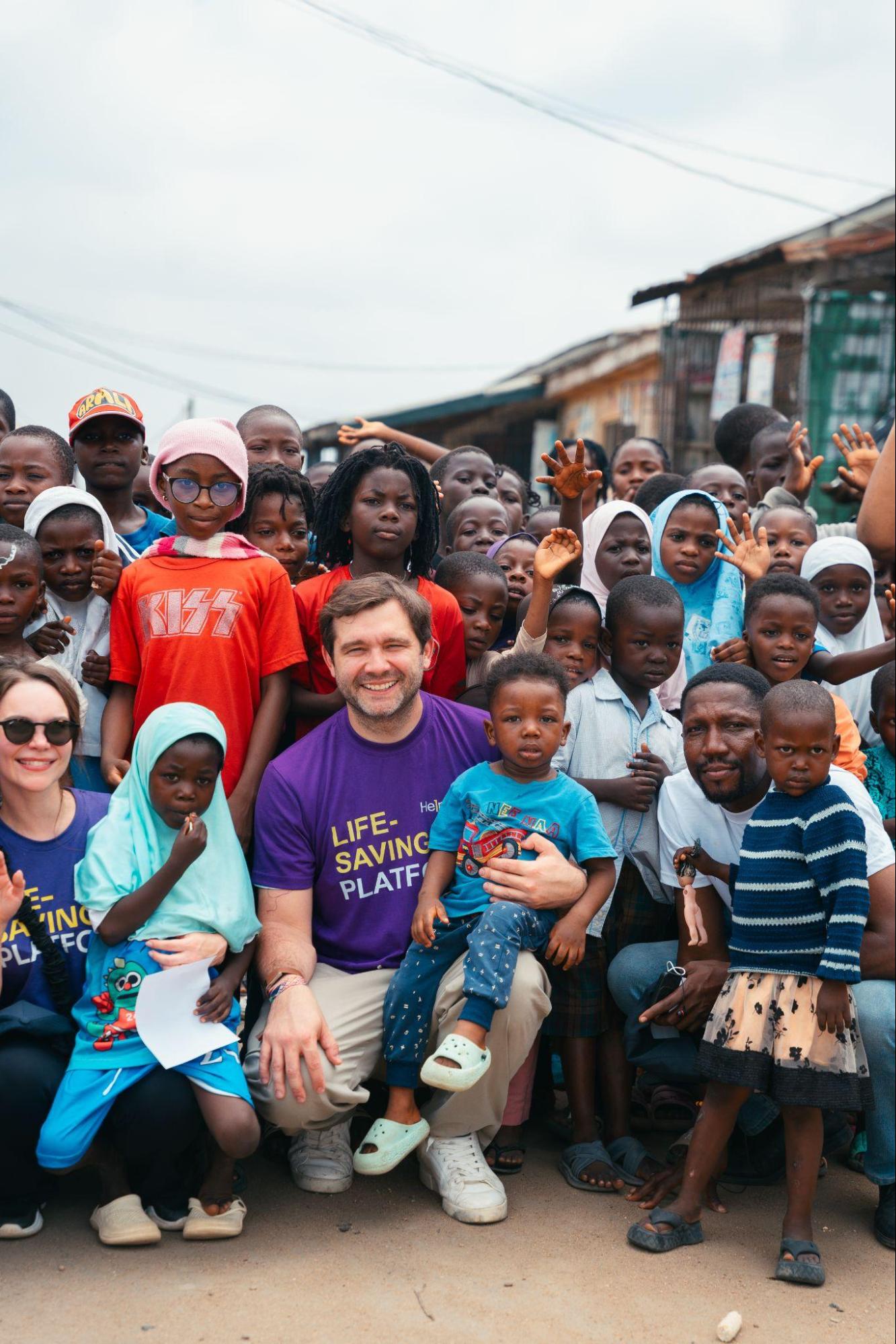
No case is funded before it is checked, according to Kuzmin. It has to arrive from a trusted source, meaning a partner hospital or a vetted local nonprofit. Then a volunteer visits the family's home. An in-house doctor confirms the medical record with the hospital. An algorithm cross-checks the data and benchmarks the quoted cost against regional averages. The same system ranks cases by urgency, but the final decision belongs to a person.
Some parts of the model travel less well than others. Helpster team members say a culture of deadlines and KPIs transfers poorly to parts of Africa and Southeast Asia. Nigeria is where the organization started, and Africa remains its center of gravity. Kuzmin says a base in Dubai helps, because a model built on local partners, doctors and physical checks works better run from nearby.
Opening a new country comes with conditions. Kuzmin lists them as the absence of free national healthcare, government permission, local registration and dependable local doctors. He assesses a prospective market by how responsive its communities, regulators and public health professionals turn out to be.
His argument with the wider sector concerns what scale has been allowed to mean. In charity, he says, scale has traditionally meant a donor's dollar vanishing into somebody else's number. A gift of thirty dollars or thirty thousand should let the giver see precisely what it accomplished.
That is also how he measures his own organization. Helpster's size matters to him less than whether other groups begin disclosing where each gift went. Setting that standard is the goal he returns to most often.
His advice to founders is that measurement is not a charity-specific problem. If a team can track a product launch, it can track a gift. Business, he says, has given entrepreneurs far more than they have given back, and the technology built for commerce should work equally well for saving lives. Startups do not wait a year to learn whether something worked; they measure, adjust and move. He built Helpster so that a slow process gets fixed that week rather than at the next annual review.
The economics of that promise are the part worth watching. A volunteer's home visit and a doctor's confirmation cost real money next to a treatment bill of a few hundred dollars, and the model only holds if those checks stay cheaper than the cases they screen as the organization adds countries. Growth here is a question of unit costs and local doctors, not of fundraising targets.
The next checkpoint Kuzmin has set is 10,000 lives saved, against a longer ambition of more than a million children. Between those two figures sits the smallest case Helpster has completed: a procedure that cost $30, for a family that could not cover it.


