The Partnership Behind the Rise of LEAP
How Mike Champion and Annabelle Mander scaled a Riyadh tech conference into a global platform for AI, investment and innovation.
Karim El-Sayed Karim El-Sayed covers company news, policy and regulation across the UAE and wider MENA for Anecdoted, with a focus on how new rules and licences reshape how startups operate. karim@anecdoted.com
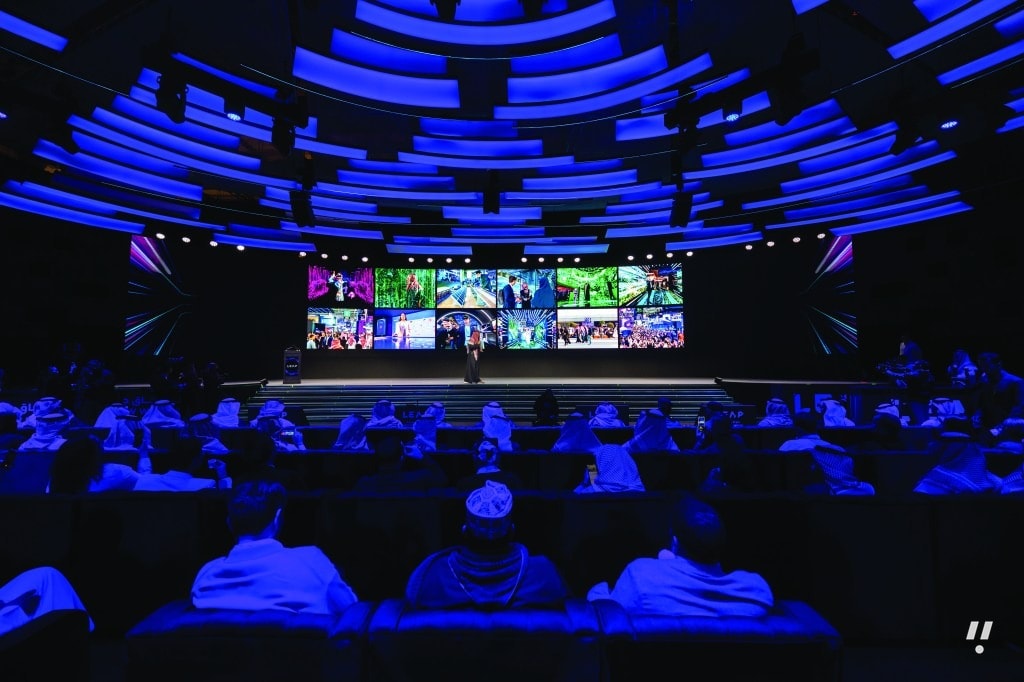
LEAP returns to RECC Malham in Riyadh from August 31 to September 3, 2026, after drawing more than 201,000 visitors in 2025. The people behind it are co-founders Mike Champion and Annabelle Mander, who built the event with the Ministry of Communications and Information Technology (MCIT) and the Saudi Federation for Cyber Security, Programming and Drones (SAFCSP).
The vehicle for that work is Tahaluf, a joint venture of Informa PLC, SAFCSP and the Events Investment Fund. It started in 2022 with five employees. It now runs 300 people and generates over US$250 million in annual revenue, with 35% growth in 2025 alone. The portfolio includes four category-defining events in under five years: LEAP, DeepFest, Money 20/20 and Black Hat MEA.
Champion puts the economic impact bluntly. Between 2023 and 2025, Tahaluf's events produced US$17.6 billion in impact, using a conservative multiplier of two rather than the industry-standard five. Over US$10 billion in property transactions closed on the show floor, and the activity supported more than 250,000 jobs. He compares that to the FIFA World Cup in Qatar, around US$17 billion, and the Paris Olympics at roughly US$11 billion. Those were one-off moments, he argues; LEAP recurs and stays.
The co-founders brought different backgrounds. Champion started in events in 2010 at IQPC, then led Informa's Saudi operations, growing revenue from US$2 million to US$180 million in four years. Mander arrived in the region at 21 for a two-day stopover that lasted over a decade. She moved through Dubai World Trade Centre and Informa Markets, then took her first big leadership role at Tahaluf during the pandemic, convincing stakeholders to scale in Saudi Arabia despite the slowdown.
Their bet was on the Kingdom's speed. Champion says he had never seen a market upscale as quickly, and that Minister Abdullah Alswaha asked for a world-class event. They declined to build something safe. Instead, they agreed to build for immediate global impact. Mander wanted outcomes, not just crowds: companies entering the market, founders raising capital, and investors finding opportunities. That principle still holds.
The turning point came on day two of the first LEAP in 2022. Invited to the Royal Court, they were told the event was exactly what the Kingdom wanted to replicate. After a year of negotiation, Tahaluf was born. Champion describes that as the moment LEAP stopped being an event and became a blueprint. He says more than a third of the events discussed in cabinet meetings chaired by the King or Crown Prince now belong to Tahaluf.
Mander sees the next chapter in LEAP East, held July 8-10, 2026, in Hong Kong. It drew 25,000 attendees, 340 speakers and 450 exhibitors. She calls it a Saudi-created model adapted for another market, not a copy. The lesson, she says, is that the Kingdom can export globally relevant platforms, not just host them.
Champion measures success in retention. Keeping staff is his most important growth driver, since teams that stay avoid relearning the same lessons. He credits a strong culture and real responsibility. Mander adds that challenge is essential, and that both of them refuse to ship anything ordinary. Their shared line, Champion says, is standards.

