UAE FIU and VARA Sign MoU on Virtual Asset Financial Crime
The agreement commits the UAE Financial Intelligence Unit and Dubai's virtual assets regulator to sharing intelligence and expertise on illicit activity in the sector.
Nadia Mansour Nadia Mansour covers fintech across the UAE and MENA for Anecdoted -- digital banking, payments licences and the startups building around them. nadia@anecdoted.com
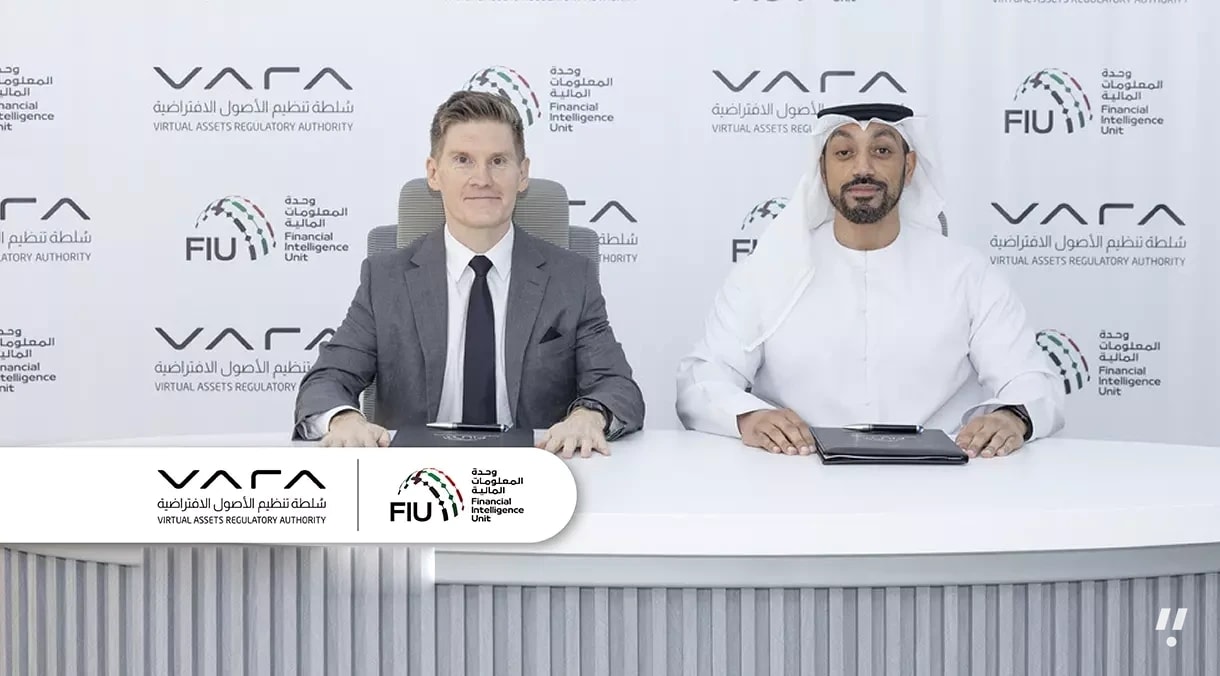
The UAE Financial Intelligence Unit and the Virtual Assets Regulatory Authority have signed a memorandum of understanding to tighten their joint response to financial crime involving virtual assets.
The document was signed by Ali Faisal Ba'Alawi, chief of the UAE FIU, and Matthew White, VARA's chief executive officer. It commits both bodies to exchanging financial intelligence and expertise, and to working more closely on detecting and addressing risks across the virtual assets sector.
Information shared under the arrangement remains bound by applicable laws and confidentiality rules. That condition covers everything the two bodies pass to one another, and it applies alongside the disclosure requirements each already follows rather than replacing them.
Two mandates over one sector
VARA supervises virtual asset activity across Dubai, with the exception of the Dubai International Financial Centre, which runs its own regime. The UAE FIU sits at the centre of the country's anti-money-laundering and counter-terrorist-financing framework, receiving and analysing suspicious transaction reports and passing its findings to law enforcement and prosecutors.
Both institutions describe their roles in tackling financial crime in the sector as complementary. The regulator holds the licensing record, the supervisory relationship and the view of individual firms. The FIU holds the wider picture of reported suspicion as it moves across banks, exchanges and remittance channels.
What the two sides said
Ba'Alawi said collaboration with VARA strengthens their collective ability to detect and analyse suspicious activity, and to understand emerging typologies and risks associated with virtual assets, which helps safeguard the integrity of the UAE's financial system.
White said continued cooperation between regulators, the UAE FIU, law-enforcement bodies and industry is essential to achieving their objectives. Neither statement signalled a change to the legal powers either body already holds.
Why the channel matters
Suspicious activity reporting from virtual asset firms is only as reliable as the supervision standing behind it. VARA decides who may operate in Dubai outside the DIFC and on what conditions; the FIU is where the resulting reports are collected, analysed and turned into leads. The agreement sets out how the two compare what they each already hold.
Typologies in this sector shift quickly. A pattern that surfaces in one quarter — a payment route, a wallet structure, a way of moving value across borders — may look different the next, and the FIU's read on those shifts depends heavily on data generated by firms that VARA alone licenses. The confidentiality rules attached to the MoU limit how freely that material can travel, so the practical effect is procedural: a defined route for sharing, not a broad grant of access.
Firms supervised by VARA keep reporting through the channels already in place. The change is in what happens at the other end, where two bodies with separate mandates now have a formal basis for comparing notes.

