Joelle Mardinian on Building Joelle Group: Trust, Smart Money and Costly Lessons
The Joelle Group founder recounted two decades of growth, a failed Saudi expansion and why she now wants an outside investor.
Karim El-Sayed Karim El-Sayed covers company news, policy and regulation across the UAE and wider MENA for Anecdoted, with a focus on how new rules and licences reshape how startups operate. karim@anecdoted.com
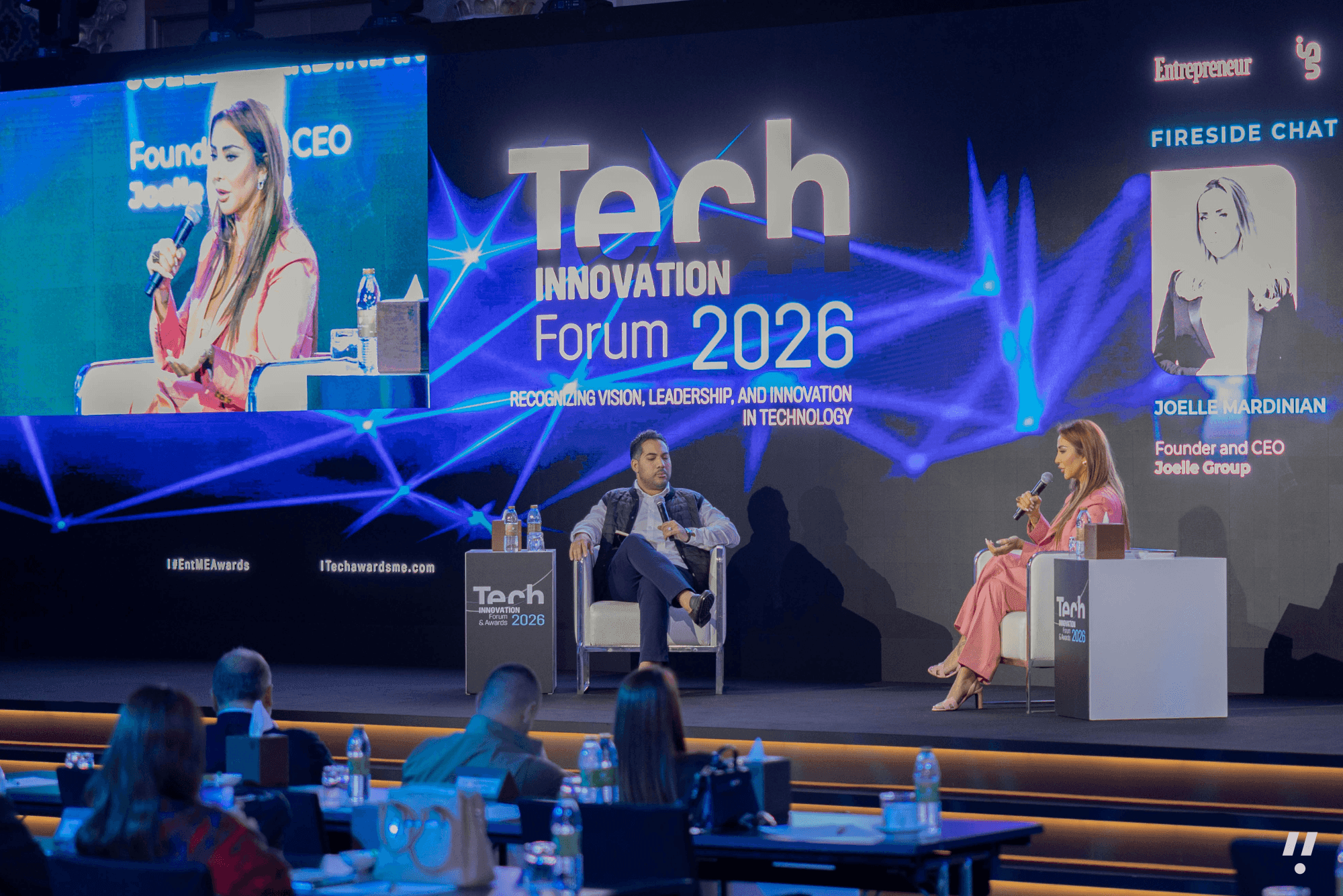
Joelle Mardinian spent nearly two decades turning a television career into Joelle Group, and at a technology innovation forum in 2026 she described the decisions and losses that shaped how she runs it. She spoke in a fireside chat with Omar Hamdi, founder and CEO of Pathos.
Her route into business was indirect. She moved to Dubai in 2004 and pitched MBC, the Saudi-headquartered broadcaster, on a makeover programme. She ended up hosting what she called the channel’s top female show, with an audience of 120 million. Viewers tied the transformations they watched to her personally, and after four years on air came offers to open a salon under her name.
“It wasn’t my decision to become an entrepreneur,” she said. “I took advantage of a situation.”
It wasn’t my decision to become an entrepreneur,
Wary that television work might not last, she founded Maison de Joelle in 2008 and grew it into a regional network of 13 salons, later adding Clinica Joelle and Joelle Paris. Her Shahid series “Joelle Unfiltered” has kept audiences close to her personal life.
Capital without counsel
A silent investor backed the first salon, support Mardinian calls essential. Her regret is how she used him: as a source of funds rather than a teacher for the parts of business she did not yet understand, accounting above all.
“I was concentrating too much on growing the business, expanding,” she said, describing hours spent on branding, marketing, PR and social media while the accounts went unattended. She says she was robbed repeatedly during those years. Smart money — a partner involved in operations — would have spared her the mistakes she had to learn from, she argues. She had the nerve and the will, she adds, but not the know-how to run a safe business.
When the investor asked for his money back, she took loans from two banks to repay him, then funded later growth herself.
A Saudi expansion that failed
She and her husband chose to enter Saudi Arabia directly with Clinica Joelle instead of franchising, betting on her Gulf audience and her standing on MBC to keep more of the returns. “My husband and I, we got greedy,” she said. “We said Saudi Arabia is my market.”
The venture lost heavily. Mardinian now thinks franchising would have been the better route, and notes they took on a partner who put in no money because that was how business was done at the time. “We lost it all,” she said. Her advice to founders is blunt: don’t get greedy.
Owned media and the human touch
Mardinian treats her social platforms as infrastructure. She has more than 50 million monthly views on Instagram, with some Snapchat videos reaching up to 20 million views a day, and began investing in those channels in 2013 so she could speak to her audience directly. Large brands keep advertising even when everyone knows them, she said, and she applies the same logic.
Authenticity, in her telling, is a business requirement. Joelle Group still runs like a family business, attentive to how clients feel as well as to what they are sold — which matters in beauty, where people arrive for personal reasons.
AI, and the investor she still wants
Asked about technology, Mardinian said AI makes her uneasy. “I’m so scared of what robots can do to us because they’re becoming so intelligent,” she said, while acknowledging that AI already shapes product development in a sector moving fast, longevity included.
She also wants outside capital. Unlike celebrity-backed brands in the US, UK and Europe, where investors and experienced teams are brought in, she said she is building with her husband, her team and her own money. “We’re succeeding, of course, but not at the rate that I would like it to be.” The investor she hopes to bring in would, she suggests, see potential in the sector rather than only in her track record.

