Lucidya's Abdullah Asiri on Why Arabic-First AI Travels
The Lucidya founder and CEO argues a decade of Arabic-language data, not local access, will decide whether the company scales beyond Saudi Arabia.
Karim El-Sayed Karim El-Sayed covers company news, policy and regulation across the UAE and wider MENA for Anecdoted, with a focus on how new rules and licences reshape how startups operate. karim@anecdoted.com
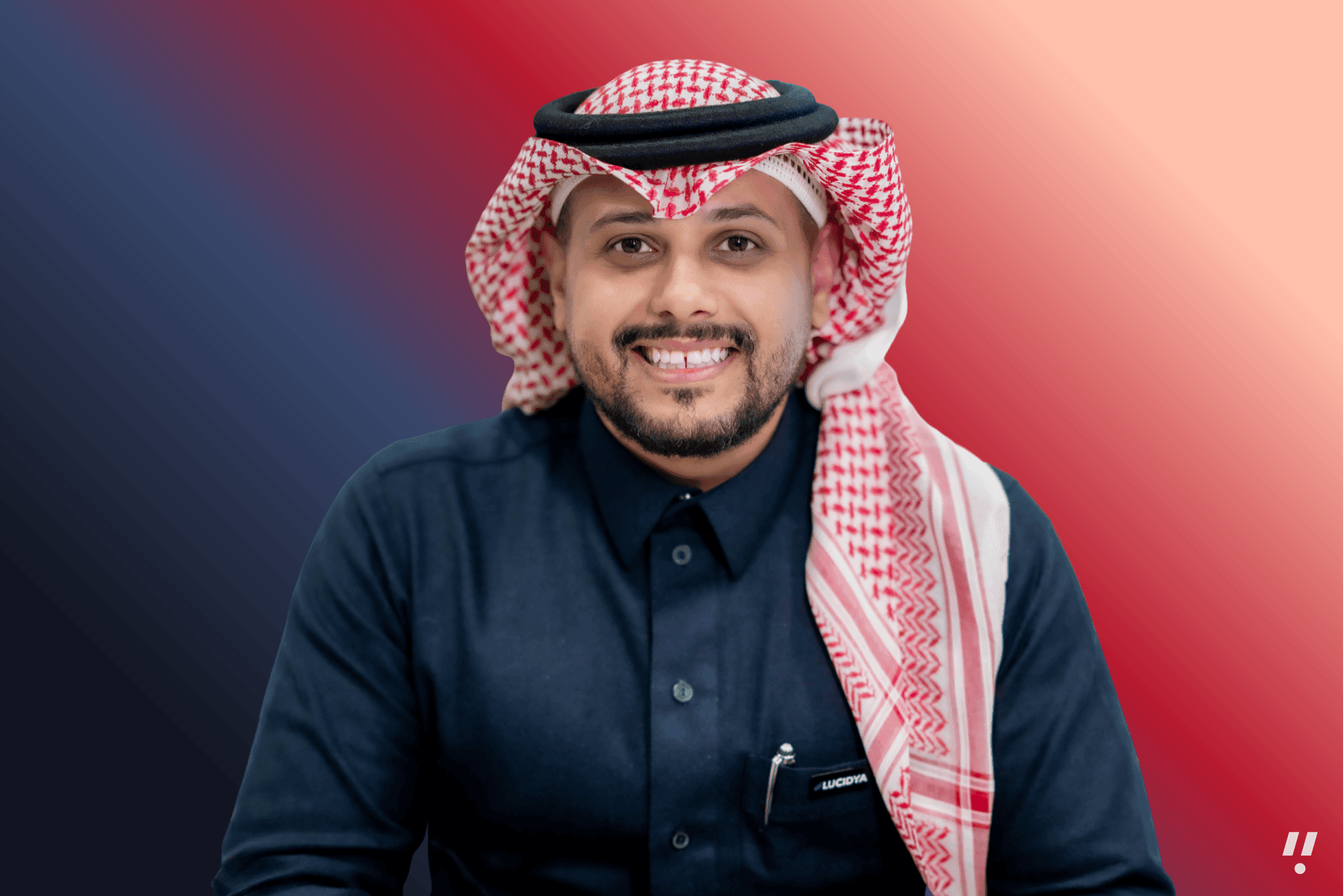
Lucidya was founded in Jeddah in 2016 by Abdullah Asiri, Hatem Kameli, Mohamed Milyani and Zuhair Khayyat, on the bet that more than 400 million Arabic speakers deserved technology built for them rather than translated for them later. It now serves customers in thirteen countries — banking, government, travel, insurance and logistics among them — and Frost & Sullivan has named it a category leader in AI-powered customer experience.
The platform bundles social listening, media monitoring, customer profiling, surveys and omnichannel engagement through OmniServe. Its proprietary models, the company says, handle seventeen Arabic dialects from Khaliji to Maghrebi at ninety-two percent accuracy.
The decisions that compounded
Asiri calls the choice to treat Arabic as the product, not a feature, the one that shaped everything else. In 2016 the cheaper route was a strong English tool with Arabic support bolted on later. Lucidya took the slower path and paid for it in harder fundraising. What it bought, he says, was ten years of Arabic conversation data, more than ten billion public posts and models trained across seventeen sub-dialects — enough for its own models to outperform general-purpose frontier models on regional dialect.
Two more calls followed. Lucidya went after public-sector work first, against the usual advice to chase faster private buyers, because serving ministries forces data residency, security certification and compliance to be solved rather than promised. That standard made later entry into banking, telecom, retail and travel a step down in friction. And when large language models arrived in 2023, the company kept its own models alongside frontier ones instead of becoming a thin layer over another vendor's API.
He is blunt about a mistake he repeats: moving too slowly on senior hires who were not working out. He now asks whether he will regret not acting sooner within six months, and moves within two weeks if the answer is yes.
From analysis to action
Roughly ten years of compounding data, more than fifty proprietary models in production and a shift from answering questions to closing cases underpin the company's claim to agentic customer experience. Its AI agent resolves issues inside a customer's own systems under policy controls, with an audit trail and escalation when warranted. In one five-month deployment it handled about eighty-five percent of eligible cases without human touch and removed roughly six thousand hours of work.
Asiri frames agentic AI as an organisational redesign that arrives disguised as a technology purchase. The common failure is deploying systems that can talk but not act, leaving a human to do the work and adding a step rather than removing one. Governance belongs at the start, he argues, and automating forty percent of a process while changing nothing else yields no savings.
Expansion on purpose
Most companies go abroad too early and for the wrong reasons, he says. Lucidya stages each move through explore, test, validate and scale, committing real money only at the last step. The Gulf counts as home. The United States, where it has customers and a sales team, is the market he cares most about precisely because no relationship can shield the product there. The rest of the region is demand-led.
He credits Saudi demand, not subsidy, as decisive, and calls regulation — data residency, personal data protection, cloud-first policy and AI ethics guidelines — the best thing that happened to the product. Lucidya holds a research grant with the Saudi Data and AI Authority and King Abdullah University of Science and Technology covering language model training methods.
Keeping an entrepreneurial culture past three hundred employees, he says, means protecting decision speed and ownership. Leaders decay it, not time. His closing advice to founders is to expect the work to take longer than planned. Lucidya is ten years old, and competing globally is only now a credible sentence rather than a hope.

