Mistral's Arthur Mensch: Open Models Cover 99% of Enterprise Use Cases
Speaking at AI Everything Abu Dhabi, Mistral AI's chief said open models, sovereign deployments and enterprise adoption — not the cost of capital — will decide the AI buildout's fate.
Karim El-Sayed Karim El-Sayed covers company news, policy and regulation across the UAE and wider MENA for Anecdoted, with a focus on how new rules and licences reshape how startups operate. karim@anecdoted.com
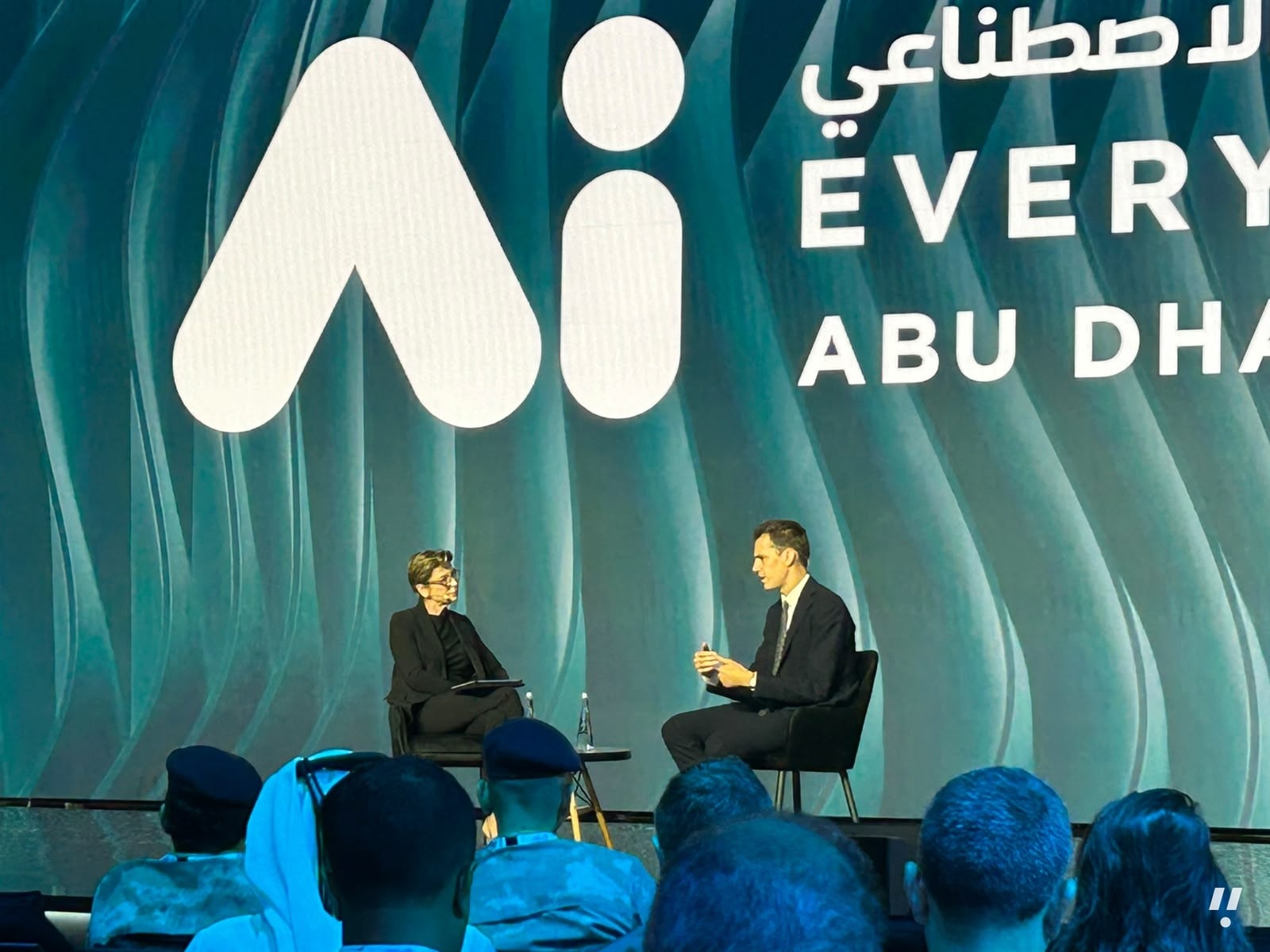
Arthur Mensch, founder and CEO of Mistral AI, used a fireside chat at AI Everything Abu Dhabi 2026 to argue that open models now cover nearly every enterprise need, and that the sector's real constraint is not the price of money but whether companies actually put the technology to work.
The session, titled “Sovereign, Open, Safe — Pick Two?”, was moderated by CNN's Becky Anderson. She opened on AI safety and increasingly capable agents, then turned to a market splitting between open and closed systems along US and Chinese lines, asking Mensch where Mistral sits in that race and about his claim that its next model will close the performance gap “very significantly.”
Mensch said there is no reason to pay the API markup attached to closed models when an open alternative can carry the job end to end. By his account, 99% of the use cases Mistral deals with today are within reach of open models, a change he said is reshaping how the market views the business model of artificial intelligence. Enterprises come out ahead through greater control, more deployment options, and the ability to hold on to their own intellectual property and use it well. He called the shift “pretty brutal,” said growth in the open market is arriving quickly, and predicted it will challenge many closed models now on offer.
Europe, the GCC and the case for hedging
Asked whether Europe can prove that sovereign, open and safe AI is possible, or else slip further behind the US and China, Mensch rejected the premise outright. “The narrative that Europe cannot compete is simply not true,” he said, pointing to the technology champions the continent already has, and describing AI sovereignty as a growing concern worldwide.
The narrative that Europe cannot compete is simply not true,
He compared AI to electricity. Countries and companies, he argued, need supply-chain strategies of their own instead of leaning on a single source. Buying US technology where it performs is sensible, but holding uncorrelated suppliers has value in a world full of uncertainty.
Europe and the GCC, he said, are closely aligned: both want to secure AI supply on the human side and the IP side so they can produce their own models — systems that understand languages other than English and carry strategic capabilities in defense and cybersecurity — without relying on manpower from the US administration. That creates a divergence of interest on this technology, and on other strategic areas such as defense, between regions that have been friends for centuries. What remains shared, he said, is an interest in IT that can be built and used outside US and Chinese borders.
Cost of capital versus adoption
On whether the infrastructure boom can survive a higher cost of capital, Mensch said financing is not the sector's biggest problem. Total cost of ownership for a cluster spans five years, and capital cost lands somewhere between 10% and 15%, so sensitivity to interest rates is fairly low. CAPEX is the largest piece of the bill. The harder issue — still something of a taboo, he admitted — is how fast enterprises adopt. Deployments depend on enterprises taking the technology up and generating growth. If the outcome is job replacement alone rather than growth, the abundance being constructed will not arrive. Adoption is the only thing that justifies the infrastructure investment, he said.
What sovereignty demands
Mensch placed sovereign AI at the center of Mistral's strategy: technology that empowers customers instead of making them dependent on the vendor. The use cases that deliver a return on investment tend to touch core processes, where agents rework an entire organization, and that involves data and IP — work that will not sit on public AI. He expects that category to grow substantially.
Asked what an organization must control before it can genuinely call its AI sovereign, Mensch listed portability between infrastructure providers, business continuity, affordability, IP control and “cultural sovereignty.” Models built in the US are English-centric, he said, and miss nuances found in other parts of the world; Arabic is one case where deliberate effort is needed to make a model good at a particular variant. Interfaces and cultural understanding matter for states that serve citizens, he added, and for companies building customer service.

