Saudi Arabia Ranks Third in Global Data Center Capacity Growth
Live IT power in the Kingdom is expanding about 23% a year as investment in data centers and digital infrastructure passes SAR 56.2 billion.
Nadia Mansour Nadia Mansour covers fintech across the UAE and MENA for Anecdoted -- digital banking, payments licences and the startups building around them. nadia@anecdoted.com
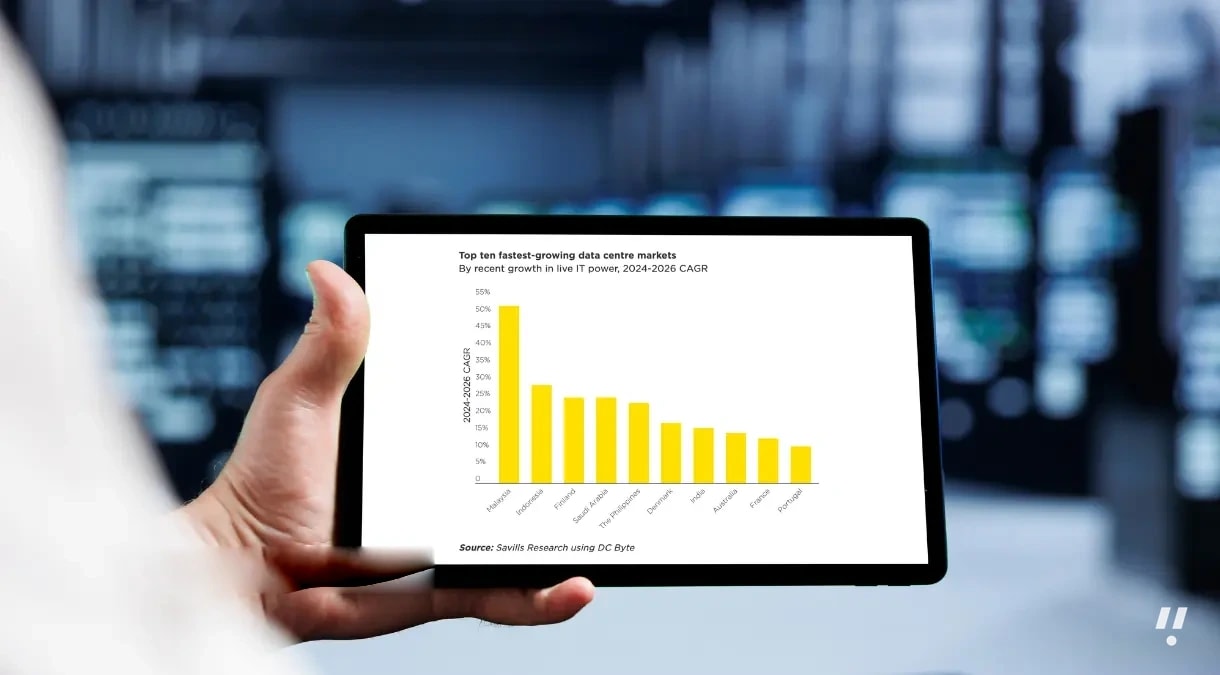
Saudi Arabia now ranks third in the world for growth in the live computing power held inside its data centers, expanding at roughly 23% a year between 2024 and 2026. Only Malaysia, at 50%, and Indonesia, at 27%, grew faster over the same stretch. Finland matched the Kingdom's pace, according to research by Savills.
Malaysia's climb started from a very low base in 2020. Its capacity is expected to reach about 2 gigawatts by the end of the year, driven largely by Johor Bahru, the city across the causeway from land- and power-constrained Singapore. Johor Bahru has 850 megawatts completed, 1.8 GW under construction and another 2.7 GW in the pipeline, putting it among the top three markets in Asia-Pacific by operational capacity alongside Tokyo and Beijing.
Indonesia and Saudi Arabia are also scaling quickly from modest starting points, at about 1.4 GW and 467 MW respectively.
Capacity in the Kingdom
Operational capacity in Saudi Arabia climbed almost sixfold, from 68 MW in 2021 to 440 MW in 2025, according to the Saudi Press Agency. Growth continued into 2026: capacity rose more than 6% in the first four months of the year across more than 60 data centers.
Investment in data centers and digital infrastructure now exceeds SAR 56.2 billion (US$14.87 billion), money tied to a national data and artificial intelligence strategy aimed at diversifying the economy and preparing it for knowledge-intensive industries.
Two projects anchor the push. Transcendence, backed by the Public Investment Fund, carries a US$100 billion price tag and is meant to build an AI ecosystem spanning innovation, infrastructure and talent. It is designed to support startups, provide room for experimentation and emphasise workforce training, AI literacy and regulation that can attract and retain specialists. Under the same banner, PIF is working with Google on an advanced AI hub expected to contribute as much as US$71 billion to the economy. The goal is a place among the world's top 15 AI hubs by the end of the decade, and to export AI solutions by then.
The second is a partnership between HUMAIN, the PIF-owned national AI company, and AirTrunk, the data center platform backed by Blackstone. Announced in October 2025, it includes SAR 11 billion (US$3 billion) for a campus in the Kingdom. The two sides are working on design, construction and operation, on equity and debt financing, and on go-to-market efforts to draw hyperscalers and enterprise customers. Local skills development is part of the remit.
Where demand is heading
The United States remains the dominant market with about 50 GW of live IT power, ahead of China at roughly 40 GW. Germany (2.7 GW), Japan (2.3 GW), the UK (2 GW), Ireland (1.5 GW) and the Netherlands (1.1 GW) are mature markets of a different scale.
Global demand for compute stood at 82 GW in 2025 and is expected to more than triple to 219 GW by 2030. Non-AI demand should rise 1.7 times, from about 38 GW to 64 GW, while AI-related demand grows 3.5 times, from 44 GW to 155 GW, roughly 70% of the total.
Middle East capacity reached about 1 GW in 2025. In the UAE, Khazna Data Centres unveiled a 100 MW AI facility in Ajman in October 2024 and plans substantially more. Qatar has drawn Microsoft and Google with digital infrastructure investment, including a US$3 billion deal involving Blue Owl Capital, and tight data security rules. Google has committed to three new data centers in Kuwait, and in Bahrain Batelco by Beyon and Qareeb Data Centers are pairing up on the country's first edge data center.

